
Standpipe Systems in San Diego: Code and Maintenance
If your San Diego commercial building is more than a few stories tall or covers a large footprint, it likely has (or needs) a standpipe system. Standpipes are the vertical piping systems that provide water connections on each floor of a building so that firefighters can connect hoses and fight fires in upper stories or remote areas without having to run hose lines from the street-level fire hydrant all the way up through the building.
Standpipe systems are a firefighting tool, not an automatic suppression system. They do not activate on their own like sprinklers. But they are a critical piece of fire protection infrastructure that the San Diego Fire-Rescue Department relies on when responding to fires in larger buildings.
When Standpipes Are Required
The California Fire Code and California Building Code require standpipe systems based on building height, area, and occupancy. The most common triggers for standpipe requirements in San Diego include buildings with any floor more than 30 feet above or below the level of fire department access, buildings with floor areas exceeding certain thresholds where hose-lay distances from exterior access points would be too long, stages in assembly occupancies that exceed 1,000 square feet, and underground buildings.
In high-rise buildings (those exceeding 75 feet to the highest occupied floor), standpipe systems are mandatory and must serve every floor.
There are three classes of standpipe systems, each designed for different uses.
Class I standpipes have 2-1/2 inch hose connections intended for use by the fire department. These are the most common standpipes in San Diego commercial buildings and are typically located in stairwells and on each floor near the stairwell entrance.
Class II standpipes have 1-1/2 inch hose connections with attached hose intended for use by building occupants. These are less common in modern construction because training building occupants to fight fires is no longer the preferred approach.
Class III standpipes combine Class I and Class II features with both 2-1/2 inch and 1-1/2 inch connections, serving both fire department and occupant use.
Connection to Other Fire Protection Systems
Standpipe systems do not operate in isolation. In most San Diego buildings, the standpipe system shares a water supply with the fire sprinkler system. The combined system must be designed so that both the sprinkler demand and the standpipe demand can be met simultaneously during a fire event.
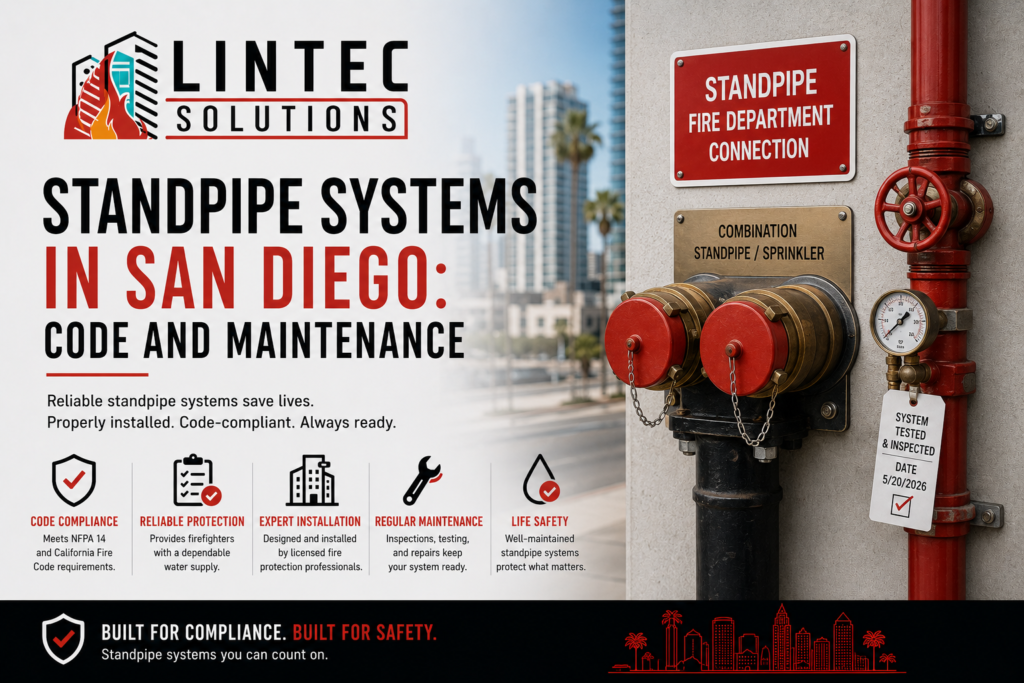
Fire department connections (FDCs) on the exterior of the building allow responding engine companies to supplement the building’s water supply by pumping into the standpipe and sprinkler system from the street. The FDC must be accessible, clearly marked, and free of obstructions at all times.
In buildings with fire pumps, the pump boosts water pressure to ensure adequate flow and pressure at the most remote and highest standpipe connections. Fire pump testing is a separate but related maintenance requirement (covered in the next section of this blog series).
The fire alarm system monitors standpipe system water flow through flow switches installed at key points. When water flows through the standpipe (indicating fire department use), the fire alarm panel registers the condition and transmits a signal to the monitoring station.
Inspection and Testing Requirements
Standpipe systems must be inspected, tested, and maintained in accordance with NFPA 25 (Standard for the Inspection, Testing, and Maintenance of Water-Based Fire Protection Systems). The testing schedule includes quarterly visual inspections of hose connections, valves, and FDCs, annual flow tests to verify adequate pressure at the most remote connection, five-year hydrostatic testing of the piping, and five-year internal pipe inspections to check for corrosion and obstructions.
All testing results must be documented and submitted through The Compliance Engine as required for all fire protection systems in the City of San Diego.
Common standpipe violations found during inspections include FDC caps that are missing, damaged, or painted over (preventing fire department use), control valves that are closed or not properly locked in the open position, pressure gauges that are broken or unreadable, hose connections in stairwells that are obstructed by storage or equipment, and missing or illegible signage identifying standpipe connections and FDC locations.
Keeping Your Standpipe System Ready
A standpipe system that is not maintained may look fine from the outside but fail to deliver adequate water pressure when the fire department needs it most. Internal corrosion, closed valves, and degraded piping can all reduce system performance without any visible indication until the system is tested.
Including standpipe testing in your overall fire protection inspection and maintenance program ensures that this critical system is verified on schedule alongside your fire alarm, sprinkler, and suppression system testing.
If your building has a standpipe system that has not been tested recently, or if you are planning a construction project that may trigger standpipe requirements under the San Diego fire code, contact Lin Tec Fire Solutions to discuss your building’s needs.





Commercial Property ManagerSan Diego, CA