
Fire Pump Testing in San Diego: What’s Required
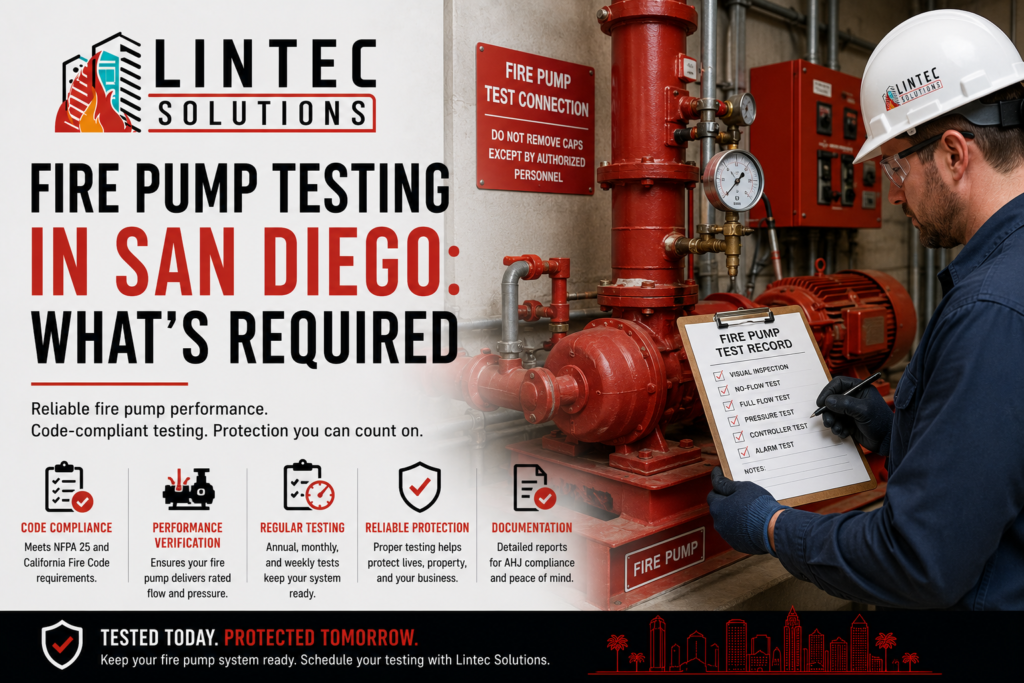
Fire pumps are the muscle behind fire sprinkler and standpipe systems in larger San Diego commercial buildings. When the water supply from the street does not provide enough pressure to reach upper floors or remote areas of the building at the flow rates required for fire suppression, a fire pump boosts that pressure to ensure the system performs as designed.
A fire pump that does not start when needed, or that runs but cannot deliver adequate pressure, means your sprinkler system and standpipe system may not function during a fire. That is why NFPA 25 (Standard for the Inspection, Testing, and Maintenance of Water-Based Fire Protection Systems) establishes one of the most rigorous testing schedules of any fire protection component for fire pumps.
Testing Schedule
Fire pump testing in San Diego follows a tiered schedule that requires attention on a weekly, monthly, and annual basis.
Weekly churn (no-flow) testing is the baseline. The pump is started and allowed to run for a minimum of 10 minutes to verify that it starts properly, operates smoothly, and the controller functions correctly. During the weekly test, the operator checks suction and discharge pressures, oil levels, cooling water flow, packing gland leakage, and any unusual vibration or noise. These tests can typically be performed by trained building maintenance staff, but the results must be documented.
Monthly inspections expand on the weekly test by including a review of the pump room conditions, the controller’s alarm and supervisory functions, and the condition of the power supply (electrical service or diesel fuel system).
Annual flow testing is the most comprehensive test. It requires a fire protection professional to flow water through the pump at multiple operating points (shutoff, rated flow, and 150% of rated flow) while measuring suction pressure, discharge pressure, and flow rate. The results are compared to the pump’s original acceptance test curve to verify that the pump is still performing within acceptable parameters.
If the annual flow test shows a decrease of more than 5% in performance from the original acceptance test, further investigation is required to determine the cause. Impeller wear, bearing degradation, suction piping obstructions, and water supply changes can all affect pump performance over time.
All test results must be submitted through The Compliance Engine as part of the building’s overall fire protection compliance documentation.
Diesel Fire Pumps Have Additional Requirements
Many larger San Diego buildings and buildings without reliable secondary electrical service use diesel-driven fire pumps. Diesel pumps have additional testing and maintenance requirements beyond those for electric pumps.
The diesel engine must be tested weekly to verify starting and running performance. Fuel supply must be maintained at a minimum of 1 gallon per horsepower for the engine, and fuel quality must be verified annually. Battery systems (most diesel fire pumps have dual starting batteries) must be tested to ensure reliable cold starts. Engine cooling systems, exhaust systems, and lubrication must all be maintained per the engine manufacturer’s requirements and NFPA 25.
Diesel fire pump maintenance is more involved and more expensive than electric pump maintenance, which is why it is critical to include it in a structured inspection and preventative maintenance program rather than leaving it to ad hoc attention.
Fire Pump Controllers and Fire Alarm Integration
The fire pump controller is the electronic brain that starts and stops the pump based on system pressure. When system pressure drops (indicating that a sprinkler head has opened or a firefighter has connected to a standpipe connection), the controller senses the pressure drop and starts the pump automatically.
The controller must be connected to the building’s fire alarm system so that pump running conditions, power supply status, and controller alarms are transmitted to the fire alarm control panel and on to the monitoring station. This integration ensures that the fire department and building management are notified whenever the pump starts, whether due to a fire condition or a system problem.
During annual fire alarm testing, the connection between the fire pump controller and the fire alarm panel must be verified. Each supervisory and alarm condition generated by the controller must be confirmed at the fire alarm panel and at the monitoring station.
Common Issues Found During Testing
The most frequent fire pump problems discovered during San Diego inspections include pumps that fail to start due to controller malfunctions or power supply issues, degraded performance discovered during annual flow testing (often caused by internal wear or suction-side obstructions), diesel engines with dead batteries, stale fuel, or failed starting sequences, jockey pump (pressure maintenance pump) cycling excessively, indicating a system leak, and missing or incomplete weekly test documentation.
Each of these issues directly affects the reliability of your building’s fire sprinkler and standpipe systems. A pump that does not start or cannot deliver rated pressure means your suppression systems may not have the water supply they need during a fire.
Getting Your Fire Pump Program on Track
Fire pump testing requires specialized knowledge and equipment, particularly for annual flow tests and diesel engine maintenance. Your fire protection contractor should have the capability to perform all levels of fire pump testing and the experience to interpret the results correctly.
If your building has a fire pump and the testing program is not current, or if your weekly test results are showing trends that concern you, contact Lin Tec Fire Solutions for an evaluation of your fire pump system and a maintenance plan that keeps it ready to perform when it matters.



Commercial Property ManagerSan Diego, CA