Paint Booth Fire Suppression in San Diego (2026)
Paint spray booths and finishing operations are among the highest fire hazard environments in any San Diego industrial or manufacturing facility. The combination of flammable vapors, atomized paint particles, ignition sources, and limited ventilation creates conditions where a fire can ignite and spread in seconds.
The California Fire Code and NFPA 33 (Standard for Spray Application Using Flammable or Combustible Materials) establish specific fire protection requirements for paint booths that go well beyond the general sprinkler and fire alarm requirements for commercial buildings. If your San Diego facility includes any spray finishing operation, understanding these requirements is critical for compliance and safety.
Why Paint Booths Are High-Hazard Environments
During spray application, flammable or combustible coatings are atomized into fine particles that become airborne. These particles, combined with the solvent vapors released from the coating material, create a flammable atmosphere inside the spray booth. Any ignition source (electrical arcing, static discharge, a hot surface, or mechanical sparks) can trigger a deflagration that spreads faster than an occupant can react.
The fire hazard does not end when spraying stops. Overspray accumulates on booth walls, filters, and ductwork. This accumulated material is a fuel source that can sustain and intensify a fire, particularly if it reaches the exhaust ductwork where airflow can accelerate flame spread.
This is why fire protection for paint booths addresses both the active spraying environment (suppressing a fire that ignites during operation) and the accumulated overspray (preventing duct fires and controlling fires in the booth enclosure).
Suppression System Requirements
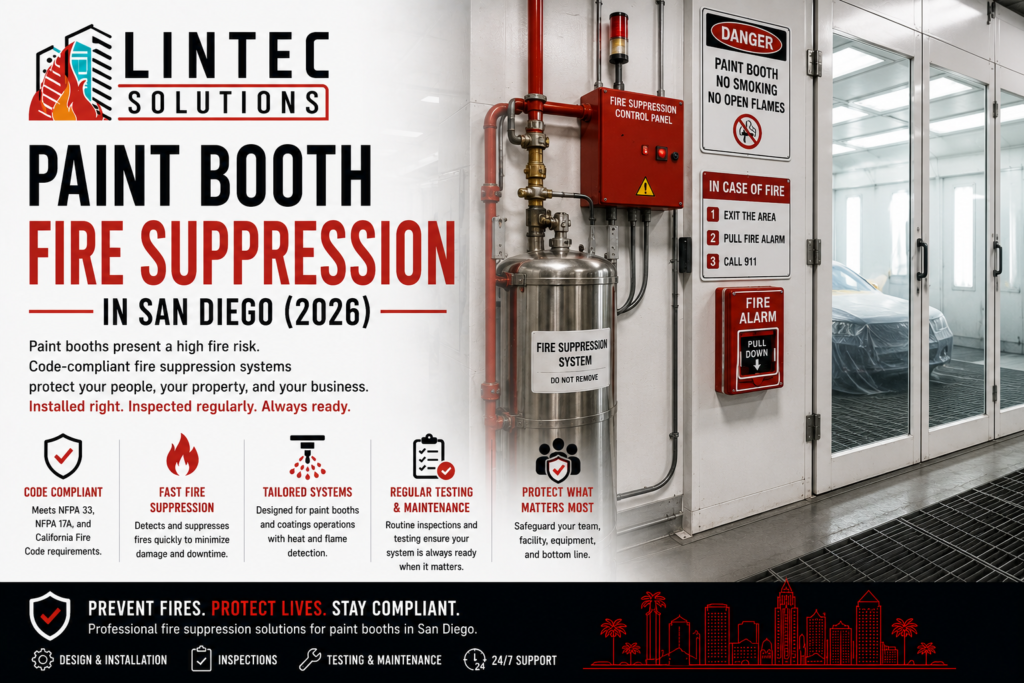
NFPA 33 and the California Fire Code require automatic fire suppression in spray booth enclosures and their associated exhaust ductwork. The type of suppression system depends on the specific hazards present.
Dry chemical suppression systems are commonly used in paint booth applications. These systems discharge a dry chemical agent (typically sodium bicarbonate or monoammonium phosphate) that interrupts the chemical chain reaction of the fire. Dry chemical systems are effective at suppressing flammable liquid and vapor fires and are designed to cover the booth interior and the exhaust plenum.
Water-based deluge systems may be required in larger booth installations or in facilities where the volume of flammable material warrants a higher level of protection. Deluge systems discharge water through open sprinkler heads across the entire protected area simultaneously when activated by a detection system.
Clean agent systems are generally not the primary suppression for paint booths due to the nature of the hazard, but they may be used to protect adjacent areas such as mixing rooms or storage areas for flammable coatings. Lin Tec Fire Solutions provides clean agent and specialty suppression systems for a wide range of industrial applications.
The suppression system must be designed to cover the spray booth interior, the exhaust plenum, the exhaust ductwork, and any areas where overspray accumulates. Nozzle placement, agent quantity, and discharge timing must be calculated by a qualified fire protection designer based on the specific booth dimensions and hazard characteristics.
Detection and Fire Alarm Integration
Paint booth suppression systems require automatic detection to initiate discharge. The detection method depends on the system type and the booth environment, but may include rate-of-rise heat detectors, UV/IR flame detectors, or fusible links in the suppression discharge piping.
The detection and suppression system must be integrated with the building’s fire alarm system so that suppression activation triggers building alarm notification and monitoring station dispatch. The system should also be interlocked with the booth’s ventilation system and electrical supply so that ventilation fans shut down and electrical power to the booth is disconnected upon suppression activation.
Inspection and Maintenance
Paint booth suppression systems require semi-annual inspection and maintenance by a licensed fire protection contractor. During these inspections, the technician verifies agent charge levels, inspects nozzles for overspray blockage (a common problem in paint booth environments), tests detection devices, checks actuation mechanisms, and verifies the interlocks with ventilation and electrical systems.
Because overspray can accumulate on suppression system components, paint booth suppression equipment requires more frequent cleaning and inspection than suppression systems in other environments. Nozzles that are clogged with paint residue will not discharge agent effectively, defeating the purpose of the system.
Regular booth cleaning, filter replacement, and overspray removal are also required by NFPA 33 and directly affect the performance of the suppression system. These maintenance activities should be coordinated with your suppression system inspection schedule so that the booth and its fire protection are maintained together.
Compliance in San Diego
The San Diego Fire-Rescue Department inspects facilities with spray finishing operations as part of their annual commercial inspection program. The fire marshal will verify that the paint booth has an approved suppression system, that the system is current on inspection and maintenance, that ventilation and electrical interlocks function properly, that fire extinguishers rated for flammable liquid fires are accessible near the booth, and that overspray accumulation is within acceptable limits.
Violations related to paint booth fire protection are treated seriously because of the high hazard classification. Correction timelines are typically short.
If your San Diego facility includes paint spray booths or finishing operations and you need a suppression system designed, installed, or maintained, contact Lin Tec Fire Solutions to discuss your specific application.





Commercial Property ManagerSan Diego, CA