
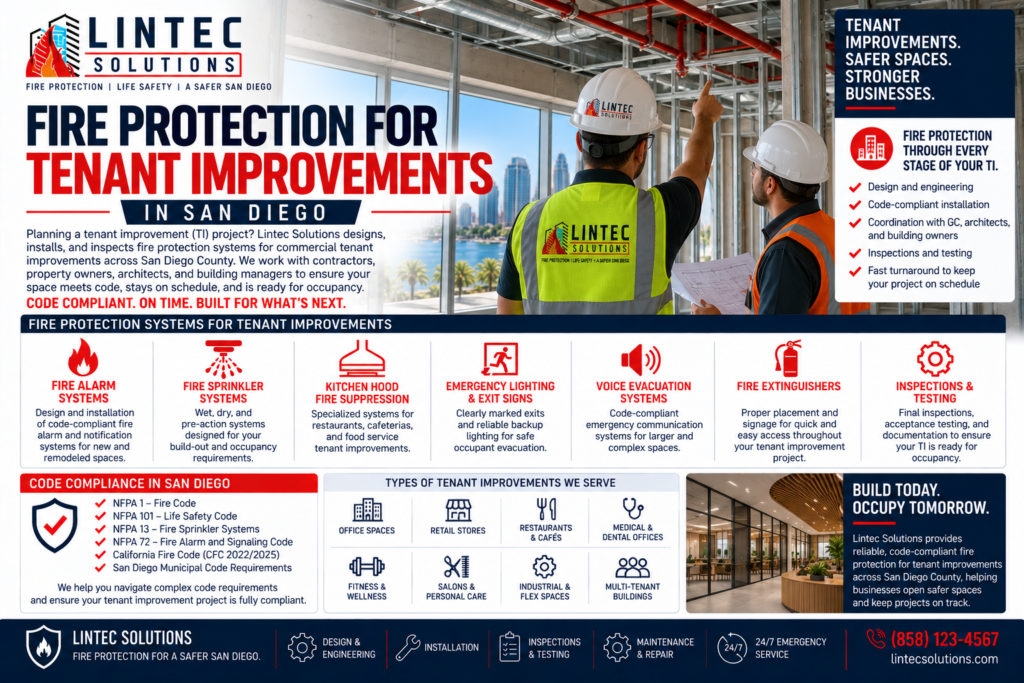
If you are building out a tenant space in San Diego, fire protection is one of the most common causes of permit delays and inspection stoppages. The City of San Diego requires fire alarm and fire sprinkler plans (or affidavits) to be submitted with the building permit application for all tenant improvement projects. If those documents are missing or incomplete, your building permit will not be issued and your project sits idle.
This requirement has been in effect since 2019, when the City eliminated the ability to defer fire alarm and sprinkler submittals to a later phase of the project. Understanding the process before you start your TI saves weeks of delays and thousands of dollars in lost time.
What the City Requires
The San Diego Development Services Department requires one of two things for every tenant improvement project that involves an existing fire alarm or sprinkler system.
Option 1: Fire alarm and sprinkler affidavits. If the scope of fire protection work is limited (generally fewer than 15 fire alarm devices and fewer than 21 sprinkler heads being added or relocated), a licensed contractor can complete the City’s affidavit forms (DS-163 for fire alarm, DS-161 for sprinkler) certifying that the work complies with NFPA 72 and NFPA 13. This is sometimes called a “no-plan permit” and is the fastest path for smaller TI projects.
Option 2: Full fire protection plans. If the scope exceeds the affidavit thresholds, or if the project involves new systems, pre-action or deluge systems, high-rise modifications, or smoke control changes, full fire alarm and/or sprinkler plans must be submitted for fire department plan review. These plans must show shop-level detail including device locations, wiring pathways, pipe routing, and hydraulic calculations.
In both cases, the fire protection documentation must be submitted with the building permit application. The building permit will not be issued until the fire protection review is complete.
What Triggers Fire Protection Modifications in a TI
Not every tenant improvement requires changes to the fire protection systems. A cosmetic refresh (new paint, carpet, furniture) typically does not trigger any fire protection work. But most TI projects that involve construction do trigger modifications.
New partition walls change the sprinkler coverage pattern. A sprinkler head that provided adequate coverage in an open floor plan may not cover the same area once walls divide the space into offices and conference rooms. Heads may need to be relocated, added, or changed to a different type to maintain code-compliant coverage.
New rooms require fire alarm devices. Enclosed offices, server closets, conference rooms, and storage rooms may need smoke detectors, notification appliances, or both. The existing fire alarm panel must have capacity for the additional devices, and the new devices must be compatible with the existing system.
Changes in occupancy type within the tenant space can trigger more significant upgrades. A space previously used as an office (Group B) being converted to a restaurant (Group A-2) or a medical office with sedation (ambulatory care provisions) will require fire protection systems that match the new, more demanding occupancy classification.
Adding a commercial kitchen triggers kitchen hood suppression requirements, fire alarm integration with the suppression system, gas shutoff interlocks, and Class K fire extinguishers.
Common TI Fire Protection Mistakes
The most frequent mistakes on San Diego TI projects that cause delays and failed inspections include the following.
Not engaging the fire protection contractor early enough. If the fire alarm and sprinkler design is not started until the architectural drawings are finalized, conflicts between the ceiling layout, mechanical systems, and fire protection devices are discovered during installation rather than during design. This results in change orders and schedule delays.
Assuming the existing system can handle the new layout. The existing fire alarm panel may not have capacity for additional devices. The existing sprinkler system’s hydraulic calculations may not support additional heads without increasing the water supply or modifying the piping. These limitations need to be identified during the design phase, not during the inspection.
Not coordinating fire protection with other trades. Fire alarm devices and sprinkler heads must be installed at specific heights and locations relative to walls, ceilings, HVAC diffusers, and lighting fixtures. When the fire protection contractor is not coordinated with the electrical, mechanical, and ceiling contractors, devices end up in the wrong locations and fail inspection.
Forgetting the fire alarm affidavit or plans. Even a simple TI that relocates a few sprinkler heads requires either an affidavit or plans. Submitting the building permit application without the fire protection documentation means the permit will not be issued. This is the single most common cause of TI permit delays in San Diego.
In Multi-Tenant Buildings
TI fire protection in multi-tenant buildings adds another layer of coordination. The building’s base fire alarm and sprinkler systems are owned by the landlord, and any modifications for a tenant build-out must be compatible with those base systems.
Many landlords require tenants to use the building’s designated fire alarm contractor for TI work to maintain system integrity. This ensures that programming is consistent across all tenant spaces, device addressing follows a logical scheme, and the annual fire alarm inspection covers the entire building without gaps.
If you are a tenant or GC working on a TI project, confirm with the landlord who is authorized to modify the building’s fire protection systems before engaging your own contractor.
Streamlining Your TI Fire Protection
The fastest way to get your San Diego TI project through permitting without fire protection delays is to engage a fire protection design-build contractor at the start of the project. They can evaluate the existing systems, determine whether an affidavit or full plans are required, prepare the submittal package, and coordinate the installation with the rest of the construction schedule.
If you have a TI project coming up in San Diego and want to get the fire protection scope defined early, contact Lin Tec Fire Solutions to discuss your project’s requirements and avoid the permitting delays that catch most TI projects off guard.





Commercial Property ManagerSan Diego, CA