
If your San Diego commercial building has a fire sprinkler system that is more than a few years old, there is a good chance corrosion is already eating away at the inside of the piping. You may not know about it until a pinhole leak causes water damage to a tenant space, or until an internal pipe inspection reveals that your system’s hydraulic performance has been compromised by buildup and blockages.
Sprinkler pipe corrosion is one of the most expensive and disruptive problems a building owner can face. The good news is that it is also one of the most preventable.
What Causes Sprinkler Pipe Corrosion
The primary driver of corrosion in fire sprinkler systems is oxygen. In wet pipe systems, trapped air pockets expose the interior pipe surface to both water and oxygen, creating the conditions for oxidation corrosion. Every time the system is drained and refilled (for testing, repairs, or modifications), fresh oxygen is introduced into the piping.
In dry pipe and pre-action systems, the problem is even more severe. These systems use compressed air to maintain supervisory pressure. That compressed air is approximately 21% oxygen. Every time the air compressor cycles to maintain pressure (which happens more frequently as leaks develop), more oxygen enters the system. The oxygen reacts with the steel pipe, producing corrosion that accelerates over time in a destructive cycle: corrosion causes leaks, leaks cause the compressor to run more, more compressor cycles introduce more oxygen, and the corrosion accelerates further.
MIC: The Biological Threat Inside Your Pipes
Beyond oxygen corrosion, fire sprinkler systems are also vulnerable to microbiologically influenced corrosion, commonly known as MIC. This is a form of corrosion driven by bacteria and microorganisms that colonize the interior surfaces of sprinkler piping.
These microbes form biofilms (also called slime layers) on the pipe walls. The colonies produce localized chemical environments that are highly acidic, creating concentrated pitting corrosion that can eat through pipe walls far faster than general oxidation alone. The byproducts of MIC include tubercles and nodules that build up inside the pipe, reducing flow capacity and potentially clogging sprinkler heads.
NFPA 13 (Standard for the Installation of Sprinkler Systems) requires that water supplies and environmental conditions be evaluated for the existence of microbes that contribute to MIC. NFPA 25 (Standard for the Inspection, Testing, and Maintenance of Water-Based Fire Protection Systems) requires that any tubercles or slime found during internal pipe inspections be tested for MIC immediately.
MIC does not only affect old systems. It can develop in systems that are only a few years old, particularly when the water supply carries elevated bacterial loads or when the system’s piping retains organic debris (pipe joint compound, cutting oils, dirt) from the original installation.
Why Traditional Solutions Fall Short
For years, the industry’s primary response to sprinkler pipe corrosion was reactive: find leaks, patch or replace the affected sections, and move on. Some facilities attempted to control MIC with chemical biocide treatments, but biocides must be continually rotated because the bacteria can develop resistance over time. Biocide programs also require ongoing chemical handling, monitoring, and cost.
None of these approaches address the root cause of the problem. As long as oxygen continues to enter the system, corrosion will continue. Patching leaks without eliminating the oxygen source is like bailing water out of a boat without plugging the hole.
The Nitrogen Generator Solution
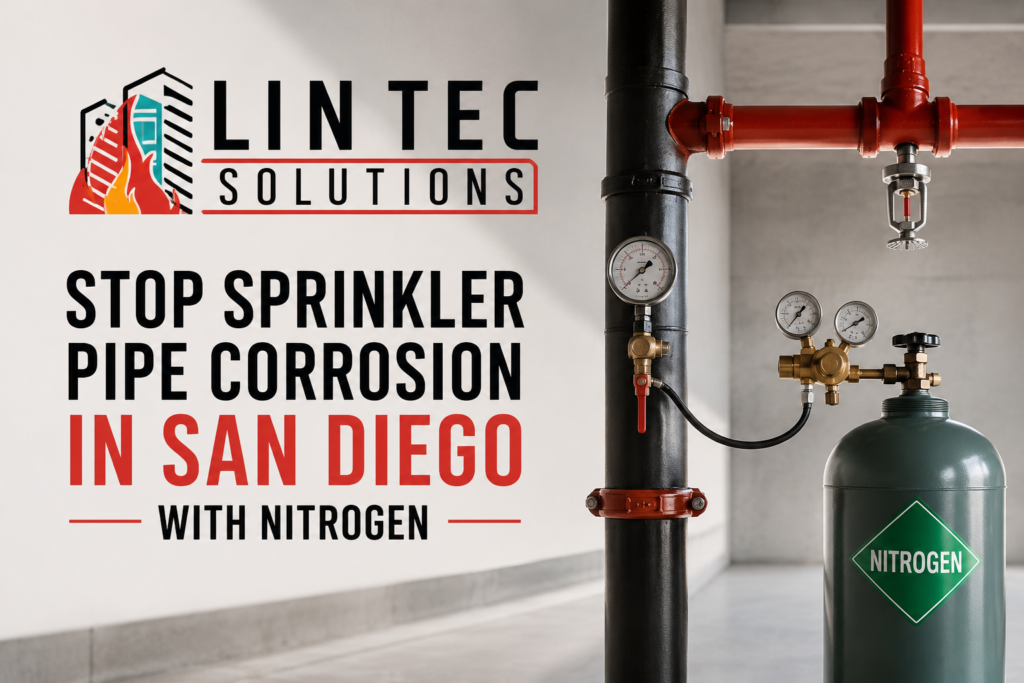
The most effective way to stop sprinkler pipe corrosion is to eliminate the oxygen that causes it. Nitrogen generator systems do exactly that by replacing the compressed air in dry pipe and pre-action sprinkler systems with 98% pure nitrogen gas.
Because nitrogen is inert (it does not react with steel), replacing oxygen with nitrogen stops the oxidation process and breaks the corrosion cycle. Research has shown that nitrogen inerting can extend the service life of fire sprinkler piping by up to 5.3 times compared to systems supervised with compressed air.
Lin Tec Fire Solutions is an authorized dealer for Engineered Corrosion Solutions (ECS), the company that pioneered nitrogen generator technology for fire sprinkler systems. ECS nitrogen generators are both FM Approved and UL 508A Listed, making them the industry standard for sprinkler corrosion control.
How ECS Nitrogen Generators Work
An ECS nitrogen generator takes compressed air (which is naturally 78% nitrogen, 21% oxygen, and trace gases) and separates the nitrogen from the oxygen using membrane technology. The result is 98%+ pure nitrogen that is fed into the sprinkler system as the supervisory gas.
The system includes automatic venting devices (such as the ECS Protector Automatic Vent or the Dry SMART Vent) that purge oxygen-rich gas from the sprinkler piping during the initial inerting process and after any system trip or drain event. Once the piping reaches the target nitrogen purity, the vents close automatically and the system maintains its inert atmosphere.
ECS offers several generator configurations to match different building and system sizes. Wall-mount and skid-mount generators handle systems up to approximately 3,200 gallons of sprinkler volume. Stand-alone generators paired with separate air compressors handle larger systems up to 22,500 gallons, making them ideal for large warehouses, parking garages, data centers, and campus environments.
ECS also offers corrosion monitoring devices that allow you to track conditions inside the piping and verify that the nitrogen inerting program is working. This monitoring capability satisfies the corrosion assessment requirements in NFPA 25 and gives you documented proof that your system is being actively protected.
Which San Diego Buildings Benefit Most
Any building with a dry pipe or pre-action fire sprinkler system is a candidate for a nitrogen generator. In San Diego, the most common applications include parking garages (unheated spaces requiring dry pipe systems), cold storage and refrigerated facilities, loading docks and unheated warehouse bays, data centers with pre-action sprinkler protection, and any building experiencing recurring pinhole leaks in sprinkler piping.
Wet pipe systems also benefit from ECS corrosion control products. ECS offers solutions for wet pipe applications that address trapped oxygen and reduce corrosion in systems where standing water creates ongoing oxidation.
If your building has experienced unexplained sprinkler leaks, if your internal pipe inspections have revealed corrosion or buildup, or if you are installing a new dry pipe or pre-action system and want to protect your investment from day one, a nitrogen generator is the most effective long-term solution available.
Getting Started
As an authorized ECS dealer, Lin Tec Fire Solutions can evaluate your existing sprinkler system, recommend the right nitrogen generator configuration for your building, and handle the full installation and commissioning process. We also provide ongoing inspection and maintenance for the nitrogen generator system and the fire sprinkler system it protects.
If you want to stop sprinkler pipe corrosion before it causes costly leaks and system failures, contact us for an assessment and find out how nitrogen inerting can protect your San Diego building’s fire protection investment.





Commercial Property ManagerSan Diego, CA