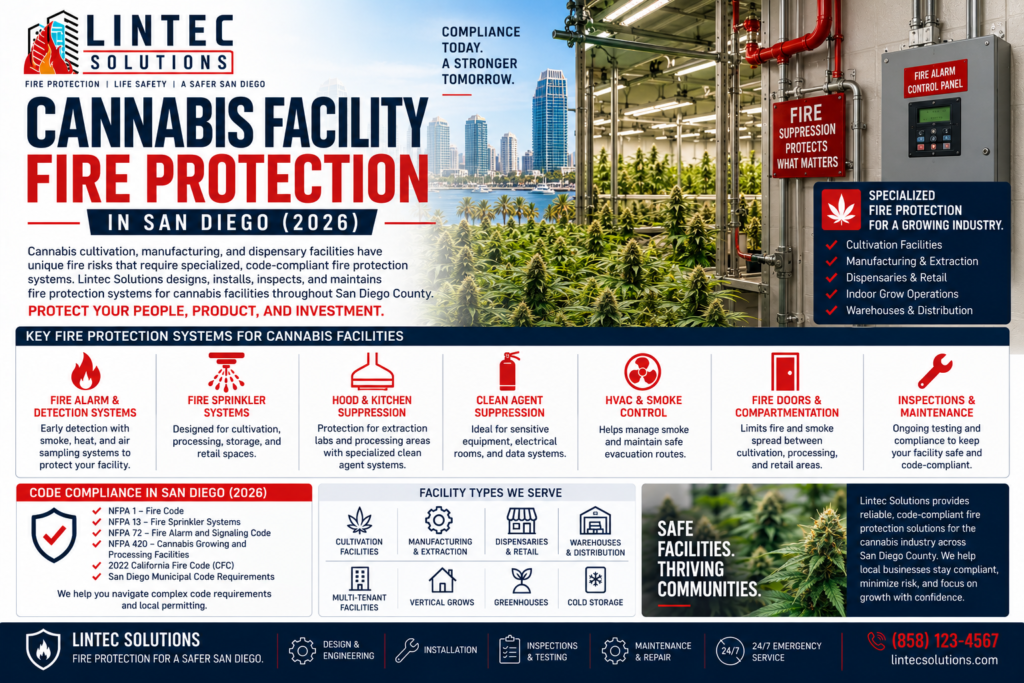
The legal cannabis industry in San Diego has grown rapidly, and with it has come an increasing need for fire protection systems designed for the unique hazards these facilities present. Cannabis cultivation, extraction, manufacturing, distribution, and retail dispensary operations each carry different fire risks, and the California Fire Code addresses them with specific provisions that go beyond standard commercial requirements.
If you operate or are planning a cannabis facility in San Diego, fire protection compliance is not just a code obligation. It is a condition of maintaining your state and local cannabis licenses, and the San Diego Fire-Rescue Department inspects licensed cannabis facilities with heightened scrutiny.
Why Cannabis Facilities Present Unique Fire Risks
Different types of cannabis operations create different fire hazards, and most facilities combine multiple operations under one roof.
Cultivation facilities use high-intensity lighting (HPS, LED, or CMH) that generates significant heat. Electrical loads are extremely high relative to the building size, creating risks of overloaded circuits, overheated wiring, and electrical fires. Environmental controls (HVAC, dehumidifiers, CO2 generators) add to the electrical demand and introduce additional heat sources. Dried cannabis plant material is combustible, and large quantities stored in drying rooms or processing areas increase the fire load.
Extraction and manufacturing facilities present the highest fire risk in the cannabis industry. Hydrocarbon extraction (using butane, propane, or other flammable solvents) creates flammable vapor atmospheres that can ignite from a spark, static discharge, or hot surface. Even closed-loop extraction systems that recapture solvents are not risk-free. Ethanol extraction uses large quantities of a flammable liquid. CO2 extraction operates at high pressures and temperatures. Post-extraction processing (distillation, winterization, formulation) may involve additional flammable solvents and heat sources.
Dispensaries and retail operations are assembly-type occupancies with public foot traffic. While the fire risks are lower than cultivation or extraction, they still require fire alarm and sprinkler systems appropriate for their occupancy classification and must comply with all retail fire protection requirements.
Extraction Room Fire Protection
Hydrocarbon extraction rooms are classified as hazardous (H) occupancies under the California Building and Fire Codes. This classification triggers the most stringent fire protection requirements available, including explosion-proof electrical systems and equipment rated for the specific hazardous atmosphere, mechanical ventilation systems designed to maintain flammable vapor concentrations below 25% of the lower explosive limit (LEL), gas detection systems that monitor for flammable vapor concentrations and automatically shut down operations and activate emergency ventilation when thresholds are exceeded, fire suppression systems designed for flammable vapor and liquid hazards, and fire-rated separation between the extraction room and adjacent occupied spaces.
The gas detection system must be integrated with the building’s fire alarm system so that hazardous atmosphere conditions trigger building alarm notification and monitoring station dispatch.
Ethanol extraction rooms also require specific fire protection, though the requirements differ from hydrocarbon extraction because ethanol has different vapor density and flammability characteristics. NFPA 30 (Flammable and Combustible Liquids Code) governs the storage and handling of ethanol in these operations.
The fire protection design for extraction operations must be performed by a team that understands both the fire code requirements and the operational realities of the extraction process. A system designed by someone unfamiliar with cannabis extraction may be technically code-compliant but operationally impractical, or worse, may miss hazards that are specific to the extraction method being used.
Cultivation Facility Fire Protection
Cannabis cultivation facilities are typically classified as Factory (Group F) or Storage (Group S) occupancies depending on the activities taking place. The primary fire protection concerns are the high electrical loads from lighting and environmental controls, the combustible plant material in drying and storage areas, and the potential for sprinkler system issues caused by the high-humidity environment.
Automatic sprinkler systems are required in most cultivation facilities based on building size and construction type. The sprinkler system must be designed to account for the actual fire load in the facility, including the quantity of dried plant material stored in drying rooms and processing areas.
The high-humidity environment in cultivation rooms can accelerate sprinkler pipe corrosion, particularly in dry pipe or pre-action systems. Nitrogen generator systems from ECS can extend the life of the sprinkler piping in these harsh environments.
Fire alarm detector selection in cultivation facilities requires careful consideration. Standard smoke detectors may generate false alarms from the dust, pollen, and particulates generated during plant handling and processing. Heat detectors or multi-criteria detectors may be more appropriate in certain growing and processing areas.
Electrical Fire Prevention
Electrical fires are the leading cause of fires in cannabis cultivation and manufacturing facilities. The electrical demands of commercial growing operations far exceed what most commercial buildings are designed to handle, and facilities that have been converted from other uses (warehouses, retail spaces, industrial buildings) may have electrical infrastructure that is inadequate for the load.
The California Electrical Code and the California Fire Code require that all electrical installations be designed and installed by licensed electricians, rated for the specific loads they will carry, and inspected by the local building department. In hazardous locations (extraction rooms), all electrical equipment must be rated for the specific hazard classification.
Proper electrical design is a fire prevention measure that directly supports the performance of your fire protection systems. An electrical fire that starts because of an overloaded circuit is exactly the scenario your fire alarm and sprinkler systems are designed to detect and control.
Licensing and Inspection Requirements
Cannabis facilities in San Diego must obtain fire clearance as a condition of their local Conditional Use Permit and their state cannabis license. The San Diego Fire-Rescue Department conducts initial fire clearance inspections before the facility opens and follow-up inspections on a regular schedule thereafter.
The fire marshal inspects every aspect of the facility’s fire protection, including fire alarm system operation, sprinkler system condition, suppression systems in extraction and processing areas, fire extinguisher compliance, emergency lighting and exit signs, hazardous materials storage and handling, gas detection system operation, electrical installation compliance, and ventilation system performance in hazardous areas.
All fire alarm and suppression system test reports must be submitted through The Compliance Engine. Maintaining current testing documentation is essential for both fire department compliance and license renewals.
Getting Your Facility Compliant
Whether you are building out a new cannabis facility, expanding an existing operation, or preparing for an inspection, a comprehensive fire protection program is essential for maintaining your license and protecting your investment.
A structured inspection and maintenance program that covers all fire protection systems on a documented schedule demonstrates the proactive compliance that regulators and insurers expect from licensed cannabis operations.
If you operate a cannabis facility in San Diego and need a fire protection contractor who understands the specific hazards and code requirements of the cannabis industry, contact Lin Tec Fire Solutions for an assessment tailored to your facility’s operations.





Commercial Property ManagerSan Diego, CA