
Most building owners choose a fire protection contractor based on price or whoever their general contractor recommends. Neither approach guarantees you will get the expertise and service quality your building requires. Here is what actually matters when evaluating fire protection contractors in San Diego.
Licensing and Credentials
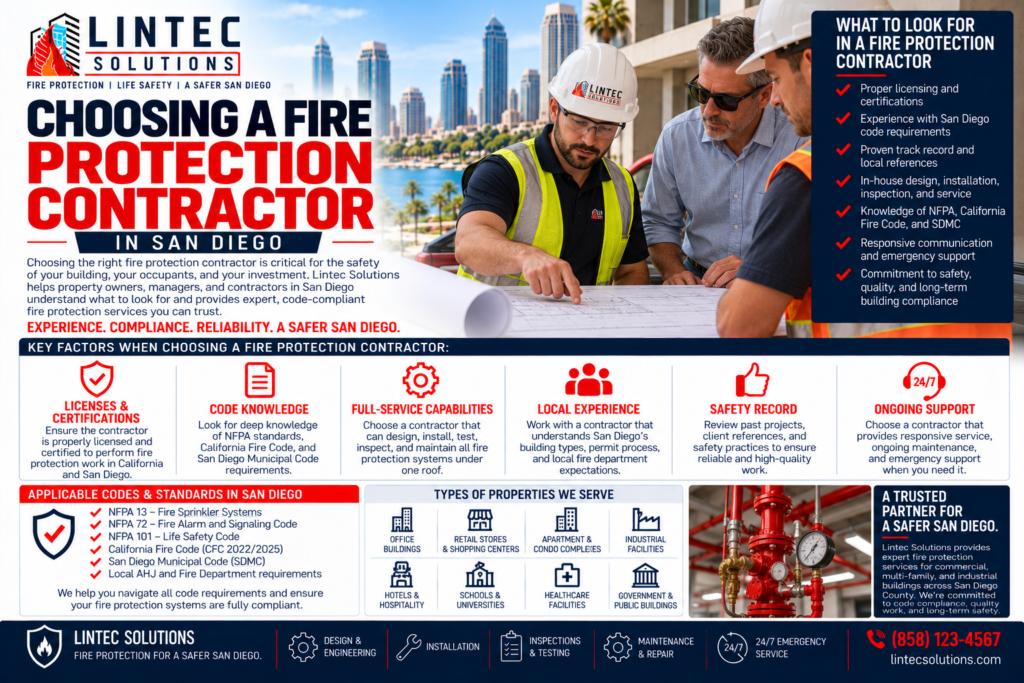
Start with the basics. California requires specific contractor licenses for fire protection work, and the license type must match the work being performed.
A C-16 Fire Protection Contractor license is required for fire sprinkler and fire suppression system installation, repair, and maintenance. A C-10 Electrical Contractor license is required for fire alarm system installation and modification. Some contractors hold both licenses, which allows them to handle all fire protection disciplines under one roof.
Verify the license through the California State License Board (CSLB) website. Check that the license is active, that the contractor’s bond and insurance are current, and that there are no unresolved complaints or disciplinary actions.
Beyond state licensing, look for NICET-certified technicians on the contractor’s team. NICET certification from the National Institute for Certification in Engineering Technologies is the nationally recognized credential that verifies individual technician knowledge in fire alarm systems and special hazard suppression systems. A contractor whose technicians hold NICET certifications has invested in verifying their team’s expertise through independent third-party testing.
For marine and vessel work, check whether the contractor is recognized by the American Bureau of Shipping (ABS). ABS recognition means the contractor’s work meets the classification standards required for classed vessels and marine assets.
Scope of Services
Fire protection is not one thing. It is a collection of specialized disciplines that must work together. The more of those disciplines your contractor can handle in-house, the better your systems will be coordinated and the simpler your compliance program becomes.
Evaluate whether the contractor can handle fire alarm system design, installation, testing, and maintenance, fire suppression system design, installation, and maintenance (including clean agent, kitchen hood, dry chemical, and inert gas systems), inspection and preventative maintenance across all system types, consulting and design services including plan preparation and fire department plan review coordination, monitoring coordination, and fire extinguisher service.
A contractor who handles only fire alarm work but not suppression, or only installation but not maintenance, means you need multiple contractors to cover your building’s fire protection needs. That creates coordination gaps, inconsistent documentation, and finger-pointing when something falls through the cracks.
San Diego Experience
Fire protection is a local business. The California Fire Code provides the baseline, but San Diego layers specific local requirements, filing processes, and enforcement practices on top of that baseline. A contractor who works primarily in other jurisdictions may not be familiar with the details that matter in San Diego.
Ask specifically about the contractor’s experience with The Compliance Engine, which is San Diego’s mandatory electronic reporting system for all fire protection system test reports. If the contractor is not registered with The Compliance Engine and does not submit reports through it, your inspection records will not be accepted by the city and you will be out of compliance regardless of how well the actual inspection was performed.
Ask about their experience with the San Diego Development Services Department plan review process. A contractor who regularly submits fire protection plans in San Diego knows what the reviewers expect, which local amendments are applied, and how to prepare submittals that move through review without unnecessary rounds of comments.
Ask about their experience with your building type. Fire protection requirements for a high-rise are very different from a warehouse, which are different from a hotel, which are different from a healthcare facility. A contractor with direct experience in your occupancy type will be more efficient, more accurate, and less likely to miss code requirements that are specific to your building.
Documentation and Reporting
Fire protection compliance is as much about documentation as it is about equipment. When the San Diego Fire-Rescue Department inspects your building, they want to see records proving that every system has been tested on schedule and that all deficiencies have been corrected.
Ask prospective contractors how they document their work. Do they provide detailed inspection reports after every visit? Do they submit reports through The Compliance Engine immediately after testing? Do they maintain a history of your building’s inspections, deficiencies, and repairs? Do they notify you of upcoming testing deadlines and code changes that affect your building?
A contractor who tests your system and then takes weeks to submit the documentation is creating a compliance gap that can be flagged during a fire department inspection. A contractor who provides same-day or next-day reporting and proactive scheduling keeps your compliance record clean.
Response Time and Emergency Service
Fire protection emergencies do not happen during business hours. A sprinkler leak at 2 AM on a Saturday, a fire alarm panel failure during a holiday weekend, or a suppression system discharge that requires immediate restoration all demand a contractor who can respond quickly.
Ask about the contractor’s emergency response capability. Do they offer 24/7 emergency service? What is their typical response time for urgent calls in San Diego? Do they stock common replacement parts and equipment, or will an emergency repair require ordering parts and waiting days for delivery?
A contractor based in San Diego County with a local parts inventory will respond faster and resolve emergencies more quickly than a contractor based hours away who has to mobilize from a distant location.
Red Flags to Watch For
Certain warning signs suggest a contractor may not deliver the quality and reliability your building requires.
Price is the only differentiator. If a contractor’s primary pitch is that they are the cheapest option, ask why. Fire protection work requires licensed technicians, proper equipment, and thorough documentation. Cutting corners on any of these creates risk. The cheapest inspection is not a bargain if it misses deficiencies that the fire department catches on their next visit.
No NICET-certified technicians. While California does not legally require NICET certification, a contractor who has not invested in certifying their team’s knowledge is relying entirely on on-the-job training. For complex systems (clean agent suppression, voice evacuation, integrated building systems), that is a risk.
Cannot explain The Compliance Engine. If a contractor working in San Diego does not know what The Compliance Engine is or how to submit reports through it, they do not have meaningful San Diego experience.
No references from your building type. A contractor who has never worked on a building like yours may learn on your project. That is fine for simple systems, but for complex occupancies like healthcare, government, or marine facilities, experience with your specific code requirements is not optional.
Reluctance to provide license and insurance documentation. Any reputable contractor will provide their license number, insurance certificates, and bonding information without hesitation. If a contractor resists providing this documentation, move on.
Making Your Decision
The right fire protection contractor for your San Diego building is licensed, experienced in your building type and jurisdiction, staffed with certified technicians, capable of handling all of your fire protection disciplines, and committed to the documentation and reporting that keeps your compliance record clean.
Lin Tec Fire Solutions holds CA License 1145562, employs NICET-certified technicians in both fire alarm and special hazard suppression, is recognized by ABS for marine work, and has extensive experience across commercial, government, and marine facilities in San Diego and Honolulu.
If you are evaluating fire protection contractors for your San Diego property, contact us for a conversation about your building’s needs and how our full-service fire protection capabilities can simplify your compliance program.





Commercial Property ManagerSan Diego, CA