Most San Diego commercial building owners think about fire protection in one of two ways: either as a set of systems that get tested once a year and otherwise ignored, or as something they deal with when the fire department shows up and finds a problem. Neither approach gives you a clear understanding of how well your building is actually protected against fire.
A commercial fire risk assessment is the process of evaluating your entire building, including its fire protection systems, its operational practices, its physical conditions, and its occupancy characteristics, to identify gaps, vulnerabilities, and areas where your current protection may not match your actual risk. It is the difference between knowing you have fire protection equipment installed and knowing that your building is actually protected.
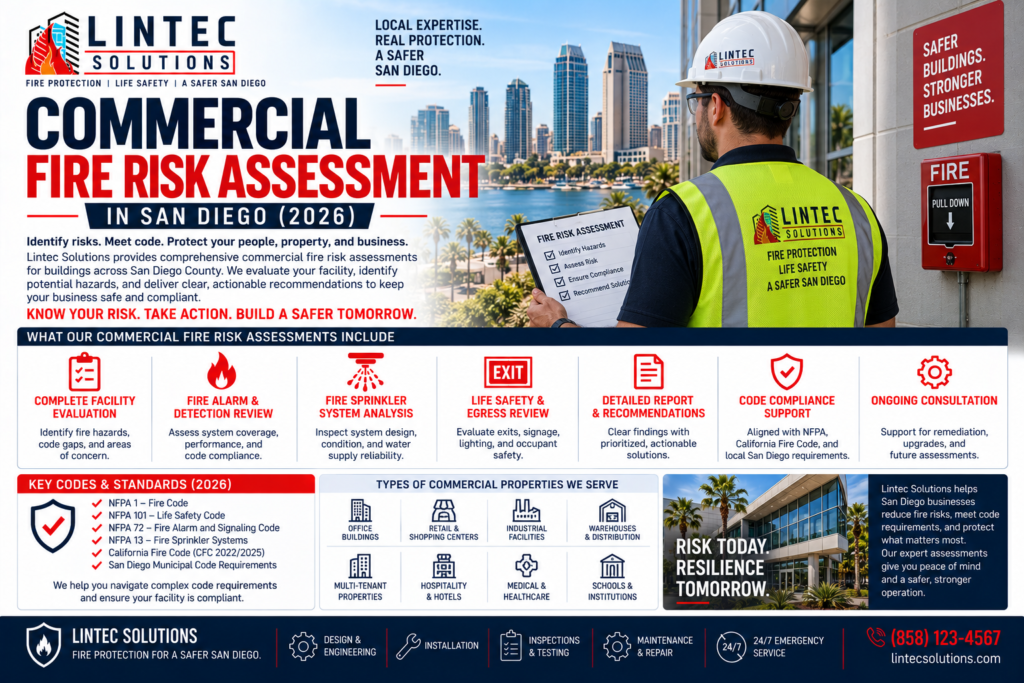
What a Fire Risk Assessment Covers
A comprehensive fire risk assessment for a San Diego commercial building evaluates multiple areas that individually may seem fine but together reveal the true picture of your building’s fire readiness.
Fire protection system condition. This goes beyond whether the systems passed their most recent annual test. The assessment evaluates whether your fire alarm system is appropriate for your current occupancy and building configuration, whether your sprinkler system is designed for the actual fire load in the building (not the fire load that existed when the system was installed 20 years ago), whether your suppression systems are current on maintenance and properly integrated with the fire alarm, and whether your monitoring pathway is reliable and meets current code.
Building construction and compartmentalization. The assessment examines the condition of your passive fire protection features. Are fire doors closing and latching properly? Are fire-rated walls and floors intact, or have renovations created unprotected penetrations? Are fire dampers functional? These passive features work alongside your active systems to contain fire and smoke, and if they have been compromised, your active systems are working harder than they should.
Occupancy and use changes. Buildings change over time. A space that was designed as an office may now be used as a medical office with sedation. A floor that was general storage may now be high-piled commodity storage. A vacant retail space may now be a brewery with flammable liquid storage. Each of these changes affects the fire protection requirements, and if the systems were not updated when the use changed, the building may be non-compliant without anyone realizing it.
Egress and life safety. The assessment evaluates whether exit paths are clear and adequate for the current occupant load, whether emergency lighting and exit signs are functional and properly located, whether the building has a current fire safety plan, and whether occupants and staff know what to do during a fire event.
Documentation and compliance history. The assessment reviews your inspection records, testing documentation, and compliance history to identify patterns. Are there recurring deficiencies that keep showing up on inspection reports? Are certain systems consistently late on their testing schedules? Is your documentation complete and submitted through The Compliance Engine as required?
Who Needs a Fire Risk Assessment
Every commercial building in San Diego can benefit from a periodic fire risk assessment, but certain situations make the assessment particularly valuable.
Building acquisition. If you are purchasing a commercial property in San Diego, a fire risk assessment before closing identifies fire protection deficiencies that may require capital investment. Discovering that the building needs a fire alarm panel replacement, a sprinkler system upgrade, or significant passive fire protection repairs after you have already closed is a costly surprise that a pre-purchase assessment could have prevented.
Insurance renewal. Insurance carriers are increasingly requesting documentation of fire protection system condition and compliance history as part of the renewal process. A fire risk assessment provides the comprehensive documentation that carriers want to see, and addressing identified deficiencies before renewal demonstrates proactive risk management that can positively influence premiums. Conversely, a history of missed inspections and lapsed maintenance can result in coverage restrictions or increased costs.
Change of use or major renovation. When a building’s use changes or a major renovation is planned, the fire protection requirements may change with it. A fire risk assessment identifies what upgrades will be triggered by the new use and helps you budget for them during the planning phase rather than discovering them during plan review or construction.
Post-incident review. If your building has experienced a fire, a fire watch event, a significant system failure, or a failed fire department inspection, a fire risk assessment helps identify the root causes and develop a corrective action plan that prevents recurrence.
Periodic reassessment. Even well-maintained buildings benefit from a comprehensive assessment every few years. Small changes accumulate over time (a renovation here, a tenant change there, an equipment addition somewhere else), and a periodic reassessment catches the gaps that incremental changes create.
How the Assessment Is Conducted
A fire risk assessment is performed by a qualified fire protection contractor or consultant who walks the entire building, reviews the fire protection systems, examines the passive fire protection features, and evaluates the building’s operations and documentation against current California Fire Code and NFPA standards.
The assessment is not the same as an annual fire alarm or sprinkler inspection. Those inspections test specific systems against specific standards. A fire risk assessment looks at the building holistically and evaluates how all of the fire protection elements work together (or fail to work together) to protect the building and its occupants.
The deliverable is a written report that identifies each finding, categorizes it by severity and urgency, references the applicable code requirement, and provides a recommended corrective action. The report gives you a prioritized roadmap for addressing deficiencies based on risk rather than guessing where to start.
The Difference Between Assessment and Inspection
An annual fire alarm inspection tests every device in your fire alarm system. A fire protection system test verifies that your sprinkler, suppression, and standpipe systems function as designed. These are essential compliance activities that must happen on schedule.
A fire risk assessment asks different questions. It asks whether the right systems are installed for your building’s current use. It asks whether the systems work together as an integrated fire protection program. It asks whether the building’s passive features support the active systems. And it asks whether the operational practices of the building’s occupants help or hinder fire safety.
The best fire protection program includes both: regular system-specific inspections and testing to maintain compliance, and periodic risk assessments to ensure the overall program is adequate for the building’s actual conditions.
What to Do with the Results
A fire risk assessment is only valuable if you act on its findings. The report gives you a prioritized list of corrective actions, and your fire protection contractor can help you develop a timeline and budget for addressing each item.
Some findings may be corrected immediately (replacing missing fire extinguishers, clearing obstructed exits, replacing missing FDC caps). Others may require planning and budgeting (upgrading the fire alarm system, adding sprinkler coverage to an unprotected area, performing fire damper inspections that have never been done).
The assessment report also becomes a valuable document for insurance discussions, property management reporting, and demonstrating due diligence in the event of a fire-related incident.
Getting Started
If your San Diego commercial building has not had a comprehensive fire risk assessment, or if significant changes have occurred since your last evaluation, now is the time to get a clear picture of where your fire protection program stands.
Lin Tec Fire Solutions provides fire risk assessments for commercial, government, marine, and industrial facilities across San Diego County. Our team evaluates your active fire protection systems, passive fire protection features, building operations, and compliance documentation to deliver an actionable report that tells you exactly what your building needs.
Contact us to schedule a fire protection assessment and get the clarity you need to protect your building, your occupants, and your investment.





Commercial Property ManagerSan Diego, CA