
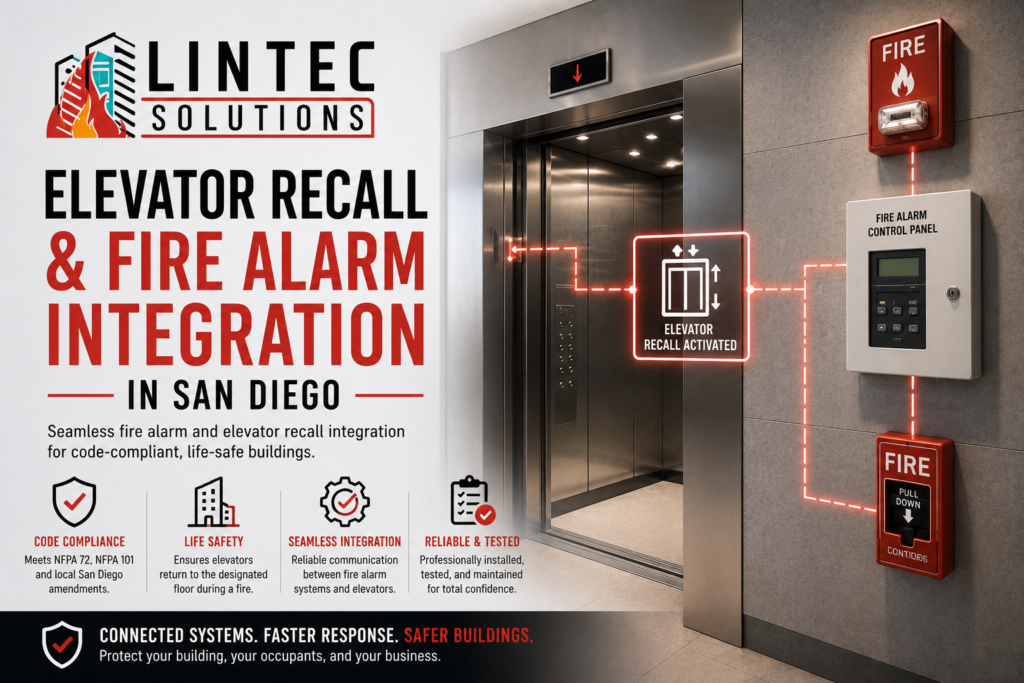
If your San Diego commercial building has an elevator, the fire alarm system and the elevator control system must be connected. This connection, called elevator recall, is a life safety function that automatically sends elevators to a designated floor when the fire alarm system activates, removing them from normal service so they are not used by occupants during a fire and are available for fire department use.
Elevator recall is not optional. It is required by the California Fire Code, NFPA 72, and the applicable elevator safety codes for every building with an elevator and a fire alarm system. Despite this, elevator recall is one of the most commonly failed test items during fire alarm inspections in San Diego.
How Elevator Recall Works
Elevator recall operates in two phases.
Phase I recall is the automatic function. When specific smoke detectors in the building activate, the fire alarm system sends a signal to the elevator controller that returns all elevators to the designated recall floor (usually the ground floor lobby). Once recalled, the elevators park with their doors open and remain out of service until manually reset by the fire department.
The smoke detectors that trigger Phase I recall are specifically located at elevator lobbies on each floor, inside the elevator machine room, and inside the elevator hoistway (if required by the installation). These detectors are separate from the general area smoke detectors in the building. Their sole purpose is to monitor the elevator environment for smoke conditions that would make elevator use dangerous.
When any of these detectors activates, the elevator recall signal is initiated. If the detector that activated is located at the recall floor itself, the elevators are sent to an alternate floor to avoid delivering occupants to the floor where smoke has been detected.
Phase II operation is the manual function that allows firefighters to take direct control of individual elevators from the fire command center. Using a key switch in the elevator car, a firefighter can override the recall and operate the elevator manually to access upper floors, transport equipment, or assist with evacuation of occupants who cannot use stairwells.
What San Diego Code Requires
The integration between fire alarm and elevator recall in San Diego must comply with NFPA 72, the California Fire Code, and ASME A17.1 (Safety Code for Elevators and Escalators). The fire alarm system must be programmed to initiate Phase I recall from the correct detectors, send the correct floor destination based on which detector activated, and provide visual and audible indication at the fire alarm control panel that recall has been initiated.
The elevator controller must be wired to receive the recall signal and execute the return sequence. The connection between the fire alarm panel and the elevator controller must be supervised so that a wiring fault is detected and reported as a trouble condition on the panel.
All of this must be tested and documented during the annual fire alarm inspection. The test must verify that activating each elevator lobby detector causes the elevators to recall to the correct floor, that activating the recall floor detector sends the elevators to the alternate floor, that the machine room detector initiates recall and generates a supervisory signal, and that Phase II key switch operation functions correctly in each elevator car.
Why Elevator Recall Fails Inspection
Despite being a straightforward concept, elevator recall fails testing with surprising frequency. The most common causes include wiring faults between the fire alarm panel and the elevator controller that have gone undetected because the circuit was not properly supervised, programming errors in the fire alarm panel that send the elevators to the wrong floor or fail to initiate recall from the correct detectors, elevator lobby detectors that were removed, relocated, or disconnected during a renovation and never reconnected, and building modifications that added a new elevator or changed the designated recall floor without updating the fire alarm system programming.
In multi-tenant buildings and high-rise buildings with multiple elevator banks, the recall programming becomes more complex and the potential for errors increases.
Coordination Between Contractors
Elevator recall involves two separate systems maintained by two separate contractors: the fire alarm contractor and the elevator service company. When these contractors do not coordinate, problems develop.
The fire alarm contractor needs the elevator company to be on site during annual testing to verify that the elevator controller responds correctly to recall signals. The elevator company needs the fire alarm contractor to confirm that the correct detectors are initiating the correct sequences.
Working with a fire protection contractor who proactively coordinates with your elevator service company for annual testing ensures that the recall sequence is verified end to end rather than tested in isolation by each contractor.
If your building has elevators and you are not confident that the recall integration is functioning correctly, schedule an assessment with a licensed fire alarm contractor who can test every phase of the recall sequence and identify any programming or wiring issues before the fire department does.





Commercial Property ManagerSan Diego, CA