
Emergency Lighting and Exit Signs in San Diego Buildings
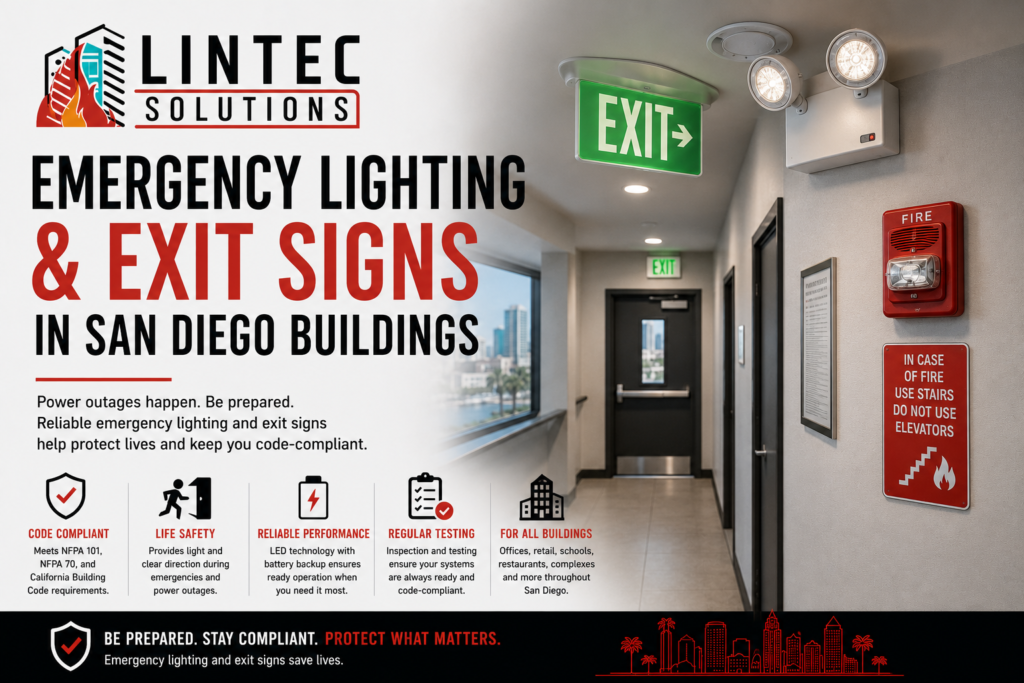
When the power goes out during a fire, the only things guiding occupants to safety are the emergency lights illuminating the path and the exit signs marking the way out. If those systems are not working, people are navigating a smoke-filled building in the dark.
Emergency lighting and exit signs are among the simplest fire protection components in a building, and they are also among the most frequently cited during San Diego fire code inspections. The violations are almost always the same: dead batteries, burned-out lamps, obstructed signs, and missing documentation.
What San Diego Code Requires
The California Fire Code and California Building Code require emergency lighting and illuminated exit signs in all commercial buildings. The specific requirements include emergency lighting along the entire path of egress from any occupied space to the building exterior, illuminated exit signs at every required exit, every exit access doorway, and wherever the direction of travel to reach an exit is not immediately apparent, emergency power for both systems that maintains illumination for a minimum of 90 minutes after normal power is lost, and minimum illumination levels of 1 foot-candle along the exit path during emergency operation.
These requirements apply to every commercial occupancy type in San Diego. Hotels, healthcare facilities, schools, retail stores, and office buildings all must meet the same baseline.
Testing Schedule
NFPA 101 (Life Safety Code) and the California Fire Code establish the testing schedule for emergency lighting and exit signs.
Monthly functional tests require activating the emergency lighting by simulating a power failure (pressing the test button on each unit or using a central testing system) and verifying that all lamps illuminate. This test should last a minimum of 30 seconds. Monthly tests can be performed by building maintenance staff but must be documented with dates and results.
Annual full-duration tests require operating the emergency lighting on battery power for the full 90-minute duration to verify that the batteries can sustain illumination for the required period. During this test, every unit is checked for proper illumination levels at the end of the 90-minute period. Units that dim or fail before the 90-minute mark need battery replacement.
Exit signs must be tested on the same schedule to verify that both the illumination source and the backup battery (for self-powered signs) or the emergency circuit (for signs powered by a central emergency system) are functioning correctly.
All test results should be documented and available during fire department inspections. While emergency lighting records are not submitted through The Compliance Engine (which covers fire alarm and suppression systems), the fire marshal will ask for test documentation during their visit.
Common Violations
Emergency lighting and exit sign violations are some of the easiest citations to avoid and some of the most common citations issued. The most frequent problems include emergency light units with dead or weak batteries that do not illuminate when tested, burned-out lamps that have not been replaced, exit signs that are not illuminated (burned-out lamps or failed LED boards), exit signs blocked by decorations, merchandise, or signage, missing emergency lights in corridors, stairwells, or other egress paths, and units that have been disconnected during renovations and never reconnected.
In multi-tenant buildings, responsibility for emergency lighting maintenance sometimes falls through the cracks between landlord and tenant. Common area emergency lighting is typically the landlord’s responsibility, while units within tenant spaces may be the tenant’s responsibility. Regardless of who maintains them, the building owner receives the violation if they are not working during an inspection.
Centralized Emergency Lighting Systems
Larger San Diego buildings may use a centralized emergency lighting system rather than individual battery-powered units. In a centralized system, emergency lighting fixtures are powered by a central battery or generator system that provides backup power to all units from a single source.
Centralized systems have the advantage of simplified maintenance (one battery system to maintain rather than dozens of individual batteries) and more consistent performance. However, they require more careful design to ensure that wiring is properly routed and protected, transfer switches function correctly, and the central power source has adequate capacity for the entire emergency lighting load.
In buildings where the fire alarm system is connected to a generator or central battery system, the emergency lighting may share that backup power source. The coordination between fire alarm backup power and emergency lighting backup power must be designed to ensure both systems can operate simultaneously for their required durations.
Incorporating Emergency Lighting into Your Maintenance Program
Emergency lighting and exit sign testing is a straightforward process that should be part of your building’s overall fire protection maintenance program. Monthly tests take minutes per unit. Annual 90-minute tests require more coordination but can be scheduled during low-occupancy periods.
The key is documentation. The fire marshal does not just want to see that your lights work today. They want to see that you have been testing them on schedule all year. A log showing monthly test dates and results, along with an annual full-duration test record, demonstrates a proactive maintenance program.
If your building’s emergency lighting has not been tested or documented recently, or if you want to incorporate emergency lighting testing into a broader fire protection compliance program, contact Lin Tec Fire Solutions to discuss how we can help.





Commercial Property ManagerSan Diego, CA