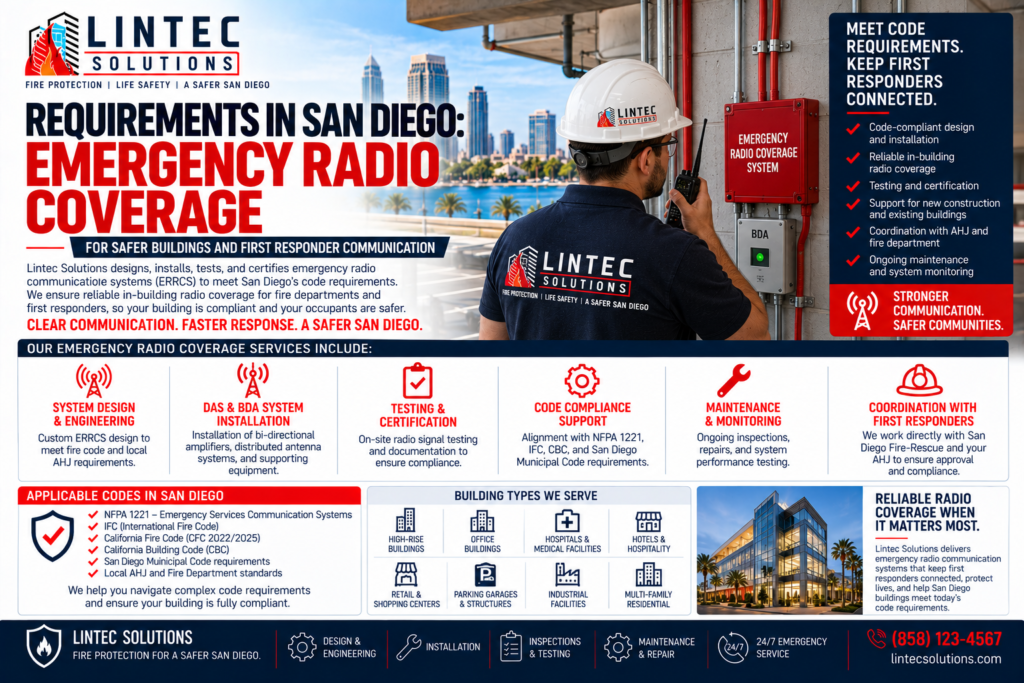
Buildings with construction materials that block or weaken radio signals (concrete, steel, tinted glass, below-grade levels, interior cores) create dangerous communication dead zones for first responders. The California Fire Code addresses this risk by requiring Emergency Responder Communication Enhancement Systems (ERCES) in buildings where radio coverage falls below acceptable levels.
If you own or are developing a commercial building in San Diego, ERCES requirements may apply to your project, and the San Diego Fire-Rescue Department is actively enforcing them.
What Is an ERCES?
An Emergency Responder Communication Enhancement System (also called an in-building radio enhancement system, a BDA system, or a first responder radio system) is a network of antennas, amplifiers, and cabling installed throughout a building to boost emergency radio signals in areas where the building’s construction blocks or degrades them.
The system works by capturing the radio signal from the public safety radio network outside the building through a donor antenna on the roof, amplifying it through a bidirectional amplifier (BDA), and distributing the boosted signal throughout the building’s interior through a network of distributed antenna system (DAS) cables and antennas installed on each floor and in below-grade areas.
The result is that firefighters, police officers, and EMS personnel can communicate clearly on their portable radios from anywhere inside the building, including stairwells, elevator lobbies, underground parking levels, and interior corridors that would otherwise be dead zones.
When ERCES Is Required in San Diego
The California Fire Code, Section 510, requires ERCES in all new buildings where radio coverage testing shows that the building does not meet minimum signal strength requirements for public safety radio frequencies. The same requirement applies to existing buildings that undergo major renovation.
The minimum signal strength threshold is defined in the code, and compliance is verified through a radio coverage test performed inside the building. The test measures signal strength on the public safety radio frequencies used by San Diego Fire-Rescue, San Diego Police, and other first responder agencies throughout the building, including all floors, stairwells, elevator shafts, below-grade levels, and interior areas.
If the test shows that any critical area of the building falls below the minimum signal strength, an ERCES must be installed to bring coverage up to the required level.
In practice, most of the following building types in San Diego require ERCES: high-rise buildings, buildings with below-grade levels (underground parking garages, basements), buildings with heavy concrete or steel construction, hospitals and healthcare facilities, large warehouses and distribution centers, hotels with interior corridors, schools and university buildings, and mixed-use developments with multiple levels.
The Permitting Process
The City of San Diego requires an ERCES permit for the installation of emergency radio enhancement systems. The permitting process involves several steps.
First, a radio coverage baseline test is performed to document existing signal strength throughout the building. This test establishes whether an ERCES is required and identifies the specific areas where signal boosting is needed.
Second, the ERCES is designed based on the baseline test results. The design must account for the building’s layout, construction materials, the number of floors, below-grade levels, and the specific radio frequencies used by San Diego public safety agencies. The system design must comply with NFPA 1225 (Standard for Emergency Services Communications) and the California Fire Code.
Third, the design is submitted to the San Diego Fire-Rescue Department for plan review and approval. The fire department reviews the design to confirm it meets code requirements and will provide adequate coverage on the frequencies their personnel use.
Fourth, after approval, the system is installed and a final radio coverage acceptance test is performed to verify that the installed system meets the required signal strength throughout the building. The fire department witnesses or reviews the results of the acceptance test before granting final approval.
Connection to Your Fire Alarm System
ERCES installations must be monitored for system integrity. The BDA equipment must be supervised so that a power failure, antenna fault, or amplifier malfunction generates a trouble signal that is reported to a monitored central station or to the building’s fire alarm system.
This monitoring ensures that a problem with the ERCES is detected and reported before the next emergency, not discovered by firefighters who cannot communicate during a fire response.
Battery backup is required to keep the ERCES operational during a power outage. The California Fire Code requires a minimum of 24 hours of standby battery power for ERCES equipment, ensuring the system remains functional during the extended power outages that can accompany major emergencies.
Annual Testing and Maintenance
ERCES installations require annual testing to verify that the system continues to provide adequate radio coverage. Over time, changes to the public safety radio network, building modifications, and equipment degradation can reduce system performance.
The annual test replicates the original acceptance test, measuring signal strength throughout the building on all required frequencies. Test results must be documented and available for review during fire department inspections.
BDA equipment requires periodic maintenance including battery testing and replacement, amplifier performance verification, antenna inspections, and firmware updates. This maintenance should be incorporated into your building’s overall fire protection inspection and maintenance program so it is tracked on schedule alongside your fire alarm and suppression system testing.
New Construction vs. Existing Buildings
For new construction, ERCES requirements are identified during the plan review process and the system is designed and installed as part of the construction project. The system must pass the acceptance test before the building receives its certificate of occupancy.
For existing buildings, ERCES requirements may be triggered by a major renovation, a change of occupancy, or a fire department inspection that identifies inadequate radio coverage. The fire department may also require ERCES as a condition of a construction permit for significant building modifications.
Retrofitting ERCES into an existing building is more complex than including it in new construction because the cable routing must work around existing building systems, ceiling types, and wall construction. Early coordination with your fire protection design team and your general contractor minimizes disruption to building operations during the installation.
Getting Started
If you own or manage a commercial building in San Diego and are not sure whether your building meets emergency radio coverage requirements, the first step is a baseline radio coverage test. This test determines whether an ERCES is required and, if so, identifies the scope of the system needed.
If you have an existing ERCES that has not been tested recently, or if you are planning a construction project that may trigger ERCES requirements, contact Lin Tec Fire Solutions to discuss your building’s emergency communication needs and how they fit into your overall fire protection program.





Commercial Property ManagerSan Diego, CA