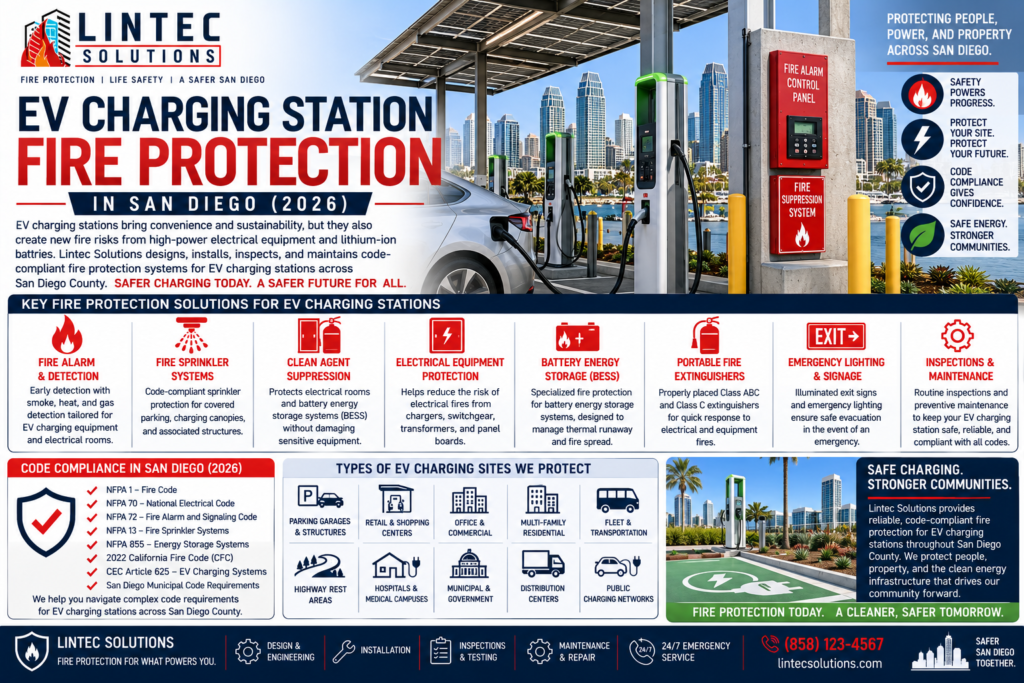
Electric vehicle adoption in San Diego is accelerating, and with it comes a growing number of EV charging stations installed in parking garages, commercial lots, workplaces, and multi-family residential buildings. These installations introduce fire risks that existing fire protection systems may not have been designed to address, and fire codes are evolving rapidly to catch up with the technology.
If you own or manage a San Diego building with EV charging stations or are planning to install them, understanding the fire protection implications now will help you avoid costly retrofits, insurance complications, and code violations as regulations tighten.
Why EV Charging Creates New Fire Risks
The primary fire risk associated with EV charging is lithium-ion battery thermal runaway. Thermal runaway is a condition where a damaged, defective, or overcharged battery cell overheats, triggering a chain reaction that can result in a fire that burns intensely, produces toxic gases, and is extremely difficult to extinguish.
EV battery fires behave differently from gasoline vehicle fires in several important ways. They burn hotter and can reach temperatures that challenge standard sprinkler system performance. They can reignite hours or even days after appearing to be extinguished as damaged cells continue to react internally. They produce toxic and flammable gases (hydrogen fluoride, carbon monoxide, methane) that create hazardous atmospheres in enclosed spaces. And they require significantly more water to cool and control than a conventional vehicle fire.
While the likelihood of an EV battery fire during normal charging is very low, the consequences when one does occur are severe, particularly in enclosed parking garages where smoke and toxic gases are trapped, adjacent vehicles are closely spaced, and evacuation routes are limited.
Current Code Requirements
Fire codes addressing EV charging are still catching up with the technology. The California Fire Code and California Building Code include provisions for EV charging station installation, and NFPA has been developing standards specifically addressing EV fire risks.
NFPA 855 (Standard for the Installation of Stationary Energy Storage Systems) addresses battery energy storage, and portions of its requirements apply to EV charging infrastructure. NFPA is also developing guidance specifically for EV charging in parking structures, though a standalone comprehensive standard is still evolving.
The current California Fire Code requirements for EV charging installations include electrical installation per the California Electrical Code (Article 625 covers EV charging equipment), compliance with the building’s existing fire protection systems (sprinklers, fire alarm, ventilation), adequate ventilation in enclosed spaces where EVs are charged, and accessibility for fire department operations.
The San Diego Fire-Rescue Department reviews EV charging installations as part of their plan review and inspection process. While requirements are still evolving, the fire department is paying increasing attention to the fire protection implications of EV charging in enclosed parking structures, particularly in high-rise buildings and mixed-use developments where parking garages sit below occupied spaces.
Sprinkler System Considerations
Most enclosed parking garages in San Diego already have fire sprinkler systems, but the existing sprinkler design may not be adequate for an EV battery fire. Standard parking garage sprinkler systems are designed for conventional vehicle fires, which produce less heat and require less water than a lithium-ion battery fire.
Building owners adding EV charging to an existing garage should have a fire protection engineer evaluate whether the current sprinkler design density and water supply are adequate for the increased fire risk. In some cases, enhanced sprinkler protection in the charging area (higher density, quick-response heads, or dedicated sprinkler zones) may be recommended or required.
For new construction, the fire protection design should account for EV charging from the start, incorporating appropriate sprinkler design in designated charging areas rather than retrofitting after the garage is built.
For garages with dry pipe systems, protecting the sprinkler piping from internal corrosion with nitrogen generators ensures the system is ready to perform when it matters most.
Fire Alarm and Detection
EV battery fires can develop rapidly and produce large quantities of smoke and toxic gases. Early detection is critical for initiating sprinkler response, activating ventilation systems, and notifying building occupants and the fire department.
Standard smoke detectors and heat detectors in parking garages provide baseline detection, but EV-specific fire scenarios may benefit from enhanced detection strategies. Linear heat detection along charging station rows, gas detection for hydrogen fluoride and other toxic emissions, and thermal imaging systems are emerging technologies being evaluated for EV charging environments.
The fire alarm system in a garage with EV charging should be integrated with the building’s ventilation system to ensure that smoke and toxic gas exhaust fans activate upon detection. In garages below occupied spaces, preventing smoke migration into the building above through fire and smoke dampers and elevator recall becomes even more important.
All fire alarm test reports must be submitted through The Compliance Engine as part of the building’s overall fire protection compliance documentation.
Ventilation and Smoke Exhaust
Ventilation is one of the most critical fire protection factors for EV charging in enclosed parking garages. The toxic gases produced by a lithium-ion battery fire make enclosed garage environments dangerous for both occupants and responding firefighters within minutes.
Existing garage ventilation systems designed for vehicle exhaust may not provide adequate smoke and toxic gas exhaust during an EV fire event. The ventilation system design should be evaluated to determine whether the exhaust rate is sufficient to manage the volume and toxicity of gases produced by a battery fire, and whether the system activates automatically upon fire detection.
For new installations, the fire protection design team should coordinate with the mechanical engineer to ensure that the ventilation system supports both normal vehicle exhaust requirements and emergency smoke and gas exhaust during a fire event.
Insurance Implications
Insurance carriers are beginning to scrutinize EV charging installations in commercial buildings, particularly in enclosed parking garages. Some carriers are requiring enhanced fire protection measures as a condition of coverage for buildings with EV charging, including increased sprinkler coverage in charging areas, enhanced detection systems, and documentation of the fire protection design rationale.
Proactively addressing the fire protection implications of EV charging before your insurance carrier asks about them puts you in a stronger position during policy renewals and demonstrates the kind of risk management that keeps premiums manageable. This is similar to how maintaining current fire protection inspection records protects your insurance coverage across all building systems.
Planning for EV Charging in Your Building
If you are adding EV charging to an existing San Diego building or designing a new building with EV charging, involve your fire protection contractor in the planning process. A fire protection assessment of the charging area can identify whether the existing sprinkler system is adequate, whether the fire alarm and detection systems need enhancement, whether the ventilation system supports emergency smoke and gas exhaust, and what additional measures (if any) should be implemented to address the emerging fire risks associated with EV charging.
The codes in this area are evolving, and what is acceptable today may not meet the requirements adopted in the next code cycle. Designing with a margin of safety now avoids costly retrofits later.
If you want to evaluate the fire protection implications of EV charging in your San Diego building, contact Lin Tec Fire Solutions for an assessment that addresses both current code requirements and the emerging best practices for EV fire protection.





Commercial Property ManagerSan Diego, CA