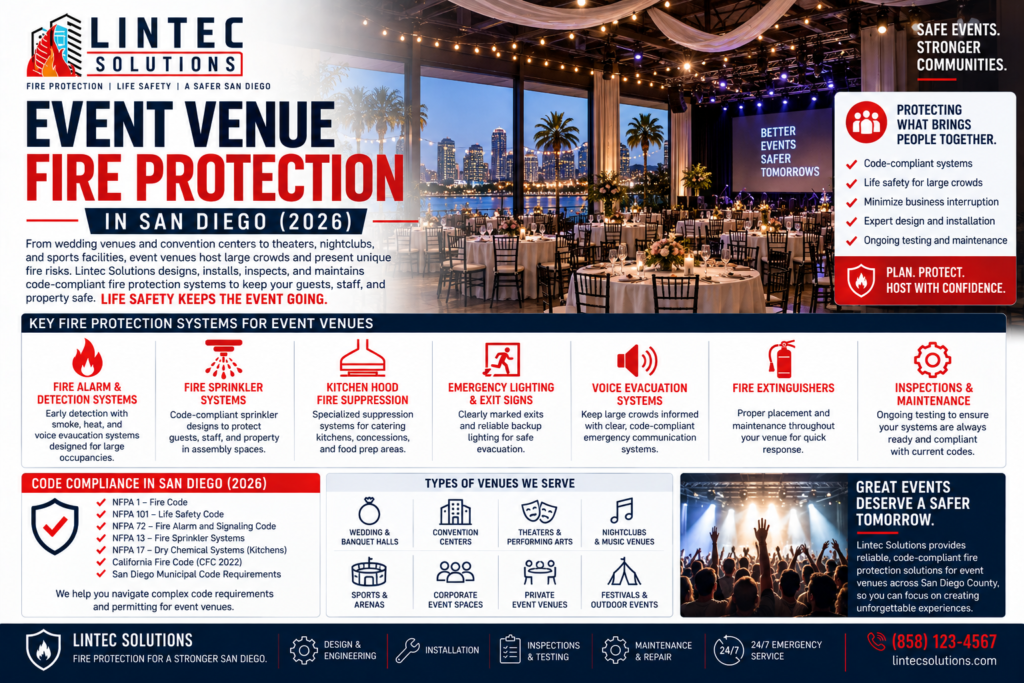
San Diego’s event industry drives a constant demand for venues that host weddings, corporate events, conferences, concerts, galas, and community gatherings. Whether the venue is a purpose-built banquet hall, a converted warehouse, a rooftop terrace, or a hotel ballroom, every event space that accommodates large groups of people falls under assembly occupancy requirements in the California Fire Code.
Assembly occupancies face some of the most detailed fire protection requirements in the code because the risk profile is elevated: large numbers of people, many of whom are unfamiliar with the building, in spaces that may be reconfigured for each event with different seating arrangements, stage setups, decorations, and equipment.
Assembly Occupancy Classification
The California Building Code classifies assembly occupancies into subcategories based on use. Event venues typically fall under Group A-2 (venues with food and drink service, banquet halls, nightclubs) or Group A-3 (general assembly without food service, conference rooms, lecture halls, exhibition spaces). Some venues with fixed seating for viewing performances may fall under Group A-1.
The classification determines specific fire protection requirements, including the type of fire alarm system required, whether automatic sprinklers are mandatory, exit width and quantity requirements based on occupant load, and the maximum occupant load the space can legally hold.
The occupant load is calculated based on the square footage of the space and the function being performed (standing, seating at tables, fixed seating, unconcentrated use). The calculated occupant load directly affects exit requirements, fire alarm notification design, and the level of fire protection the building must provide.
The San Diego Fire-Rescue Department posts maximum occupancy loads for event venues and checks compliance during inspections. Exceeding the posted occupancy is a serious violation that can result in immediate shutdown of the event.
Fire Alarm and Notification Requirements
Event venues in San Diego require fire alarm systems with manual pull stations at all exits, smoke detection in corridors, storage rooms, and back-of-house areas, and notification appliances throughout the venue that meet audibility and visibility requirements even during loud events.
The audibility requirement is a significant challenge for event venues. During a concert, DJ set, or large reception with amplified music, the ambient noise level can easily exceed 100 decibels. Standard fire alarm horns may not be audible above that noise level, which means occupants may not hear the alarm during an emergency.
Voice evacuation systems are increasingly specified for San Diego event venues because spoken messages can cut through ambient noise more effectively than tone-only horns. The system can also be integrated with the venue’s sound system to automatically interrupt the entertainment audio and deliver evacuation instructions through the house speakers.
For venues that host events with varying noise levels, the fire alarm notification design must account for the worst-case scenario. A system designed to be audible during a quiet corporate lunch will not be adequate during a loud reception with a live band.
All fire alarm test reports must be submitted through The Compliance Engine, and annual fire alarm inspections must verify that the system meets code requirements under the conditions the venue actually operates in.
Sprinkler and Suppression Systems
Most event venues in San Diego require automatic fire sprinkler systems based on building size and occupant load. The sprinkler design must account for the open floor plans, high ceilings, and large unobstructed areas that are characteristic of event spaces.
Venues with commercial kitchens or catering preparation areas require kitchen hood suppression systems and must follow the same hood cleaning schedule as any commercial kitchen in San Diego. Even venues that rely on outside caterers must maintain their kitchen suppression systems if the building has permanent cooking equipment.
Venues with stages, performance areas, or exhibit halls may require additional suppression considerations depending on the combustible materials used in stage sets, drapery, and decorations.
Decorations, Drapery, and Open Flame
Event decorations are one of the most common fire code issues in San Diego venues. The California Fire Code requires that all decorative materials used in assembly occupancies be flame-resistant or treated with an approved flame retardant. This includes drapery, fabric backdrops, paper decorations, artificial foliage, and any material hung from the ceiling or walls.
The fire marshal may request flame-resistance documentation (certificates from the manufacturer or the flame treatment provider) for decorative materials, particularly for large events. Untreated fabric drapes, paper streamers, and natural greenery that has not been treated are common violations.
Open flame use (candles, fire pits, sparklers, pyrotechnics) in assembly occupancies requires compliance with the California Fire Code’s open flame provisions. Candles must be in non-combustible holders, properly supported, and kept away from combustible decorations. Any use of pyrotechnics or special effects requiring flame requires a permit from the San Diego Fire-Rescue Department and may require a fire watch during the event.
Exit Requirements and Egress Planning
Exit capacity is calculated based on the occupant load of the venue. The total width of all exits must be sufficient to allow the entire occupant load to evacuate within the time frame required by code. Exit doors in assembly occupancies must swing in the direction of travel (outward), must be equipped with panic hardware when serving occupant loads above 50, and must not be locked or blocked during any event.
Emergency lighting and exit signs must be operational along the entire egress path. For venues that use theatrical lighting or dim ambient lighting during events, the contrast between the darkened venue and the illuminated exit signs becomes the primary wayfinding tool for occupants during an emergency.
Event setup must never block, reduce, or obstruct exits. Tables, chairs, staging, audiovisual equipment, and decorations must be arranged to maintain clear egress paths to all exits. This is one of the most frequently violated requirements in San Diego event venues, particularly when event planners try to maximize seating capacity by encroaching on exit corridors.
Temporary Events and Pop-Up Venues
San Diego’s outdoor event culture creates additional fire protection considerations. Temporary event structures (tents, canopies, stages) that exceed certain size thresholds require fire department permits and may need temporary fire protection measures including portable fire extinguishers rated for the hazards present, exit signage and emergency lighting, flame-resistant tent fabric with documentation, clearance from cooking equipment and heat sources, and a fire safety plan for the event.
Pop-up event spaces in converted warehouses, industrial buildings, or other non-traditional venues must meet the same assembly occupancy requirements as purpose-built venues. Converting a warehouse to an event space without addressing the fire code requirements for assembly occupancy is a serious violation that can result in event shutdowns and penalties.
Keeping Your Venue Compliant
Event venue fire protection compliance requires attention to both the installed fire protection systems and the operational practices that change with every event. A structured inspection and maintenance program keeps your fire alarm, sprinkler, suppression, and fire extinguisher systems compliant. Operational compliance (exit management, decoration standards, occupancy limits, open flame procedures) is the venue operator’s responsibility for every event.
If you own or manage an event venue in San Diego and want to verify that your fire protection systems and operational practices meet current code, contact Lin Tec Fire Solutions for a comprehensive assessment.





Commercial Property ManagerSan Diego, CA