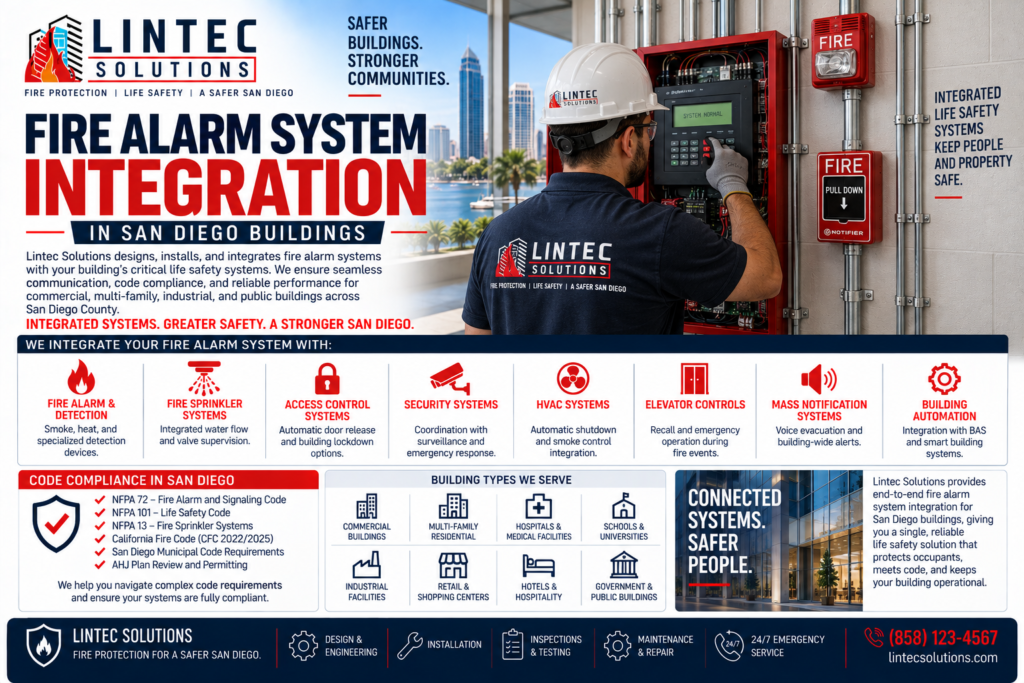
A fire alarm system in a modern San Diego commercial building does far more than detect smoke and sound a horn. It is the central nervous system that coordinates the response of every other building system during a fire event. When the fire alarm activates, it triggers a chain of automated responses across multiple building systems, and if those connections are not properly designed, installed, and tested, the building’s emergency response falls apart.
The fire alarm control panel is the hub that connects to and controls these systems. Understanding what must integrate with the fire alarm, how those integrations work, and what happens when they fail is essential for every San Diego building owner and facility manager.
What Integrates with the Fire Alarm System
In a typical San Diego commercial building, the fire alarm system interfaces with multiple building systems. Each integration serves a specific life safety function.
HVAC systems. When the fire alarm activates, the system sends shutdown signals to air handling units to prevent the HVAC system from distributing smoke throughout the building. Smoke dampers in ductwork close on signal from the fire alarm panel to compartmentalize the duct system. In buildings with smoke control systems, the fire alarm initiates pressurization of stairwells and exhaust of smoke from the fire floor.
Elevator systems. Elevator recall is one of the most critical fire alarm integrations. Smoke detectors at elevator lobbies, in the machine room, and in the hoistway send signals to the fire alarm panel, which then sends a recall signal to the elevator controller. The elevators return to the designated floor and park with doors open.
Fire suppression systems. Fire suppression systems including clean agent systems, kitchen hood systems, and pre-action sprinkler systems are triggered by the fire alarm detection system. The fire alarm panel processes the detection signal and initiates the suppression discharge sequence. For clean agent systems, this typically involves a cross-zone confirmation before discharge to prevent accidental release.
Door holders and closers. Fire doors held open by magnetic hold-open devices release and close when the fire alarm activates. This maintains the compartmentalization of the building by closing openings in fire-rated barriers. Access control systems on fire-rated doors must also release to allow free egress during an alarm condition.
Sprinkler monitoring. Water flow switches and supervisory switches on the sprinkler system and standpipe system connect to the fire alarm panel. When a sprinkler head activates and water flows, the flow switch signals the panel, which transmits an alarm to the monitoring station. Supervisory switches monitor valve positions and signal the panel if a valve is closed.
Fire pump monitoring. Fire pump controllers connect to the fire alarm panel to transmit pump running status, power supply conditions, and controller alarms. This ensures the fire department and building management are notified when the pump operates.
Emergency power and lighting. The fire alarm system may interface with the building’s emergency generator transfer switch to confirm that emergency power is available. Emergency lighting activation may be coordinated with fire alarm conditions in some building configurations.
Building management systems (BMS). In larger San Diego buildings, the fire alarm system communicates with the BMS to provide fire condition status, coordinate HVAC responses, and display alarm information at the building engineer’s workstation. This integration is for monitoring and coordination only. The fire alarm system must be capable of performing all life safety functions independently of the BMS, per NFPA 72.
Why Integration Matters
Each of these integrations serves a specific purpose in the building’s emergency response. When they work together, the building responds to a fire automatically and comprehensively: smoke is detected, occupants are notified, smoke spread is controlled, elevators are recalled, suppression is initiated, and the fire department is dispatched.
When an integration fails, a gap opens in the response. An HVAC system that does not shut down spreads smoke to floors that should be protected. An elevator that does not recall delivers occupants into a smoke-filled lobby. A suppression system that does not receive its trigger signal from the fire alarm does not discharge. A fire door that does not release stays open and allows fire and smoke to spread through the barrier.
These failures are not theoretical. They are discovered during annual fire alarm inspections with surprising frequency, particularly in buildings where different contractors have worked on different systems over the years without coordinating their programming and wiring.
Common Integration Failures
The most frequent integration problems found during San Diego fire alarm inspections include HVAC systems that do not shut down on fire alarm because the relay connection between the fire alarm panel and the air handler has been disconnected or was never properly wired, elevator recall sequences that send elevators to the wrong floor or do not initiate at all because the programming was not updated after a building modification, suppression systems that do not receive the discharge signal because the fire alarm zone that triggers the suppression was reprogrammed during a panel update and the suppression connection was not verified, fire door holders that do not release because the magnetic devices have been disconnected, replaced with non-listed hardware, or wired to a circuit that is no longer supervised by the fire alarm panel, and sprinkler supervisory switches that do not report to the monitoring station because the communication pathway between the fire alarm panel and the monitoring station has degraded or been disconnected.
Each of these failures represents a life safety gap that may not be discovered until the system is tested or, worse, until a real fire occurs.
Testing Integration Points
Every integration between the fire alarm system and another building system must be tested during the annual fire protection system testing program. This means physically activating the fire alarm condition that triggers each integration and verifying the response at the connected system.
Testing elevator recall requires the fire alarm contractor and the elevator service company to be on site simultaneously. Testing HVAC shutdown requires verification at each air handler. Testing suppression integration requires verification that the discharge sequence initiates correctly from the fire alarm signal. Testing door holder release requires walking to every hold-open device and confirming closure.
This cross-system testing is one of the strongest arguments for working with a single fire protection contractor who manages the fire alarm, suppression, and inspection programs for the building. A single contractor has visibility into all of the integration points and can coordinate the testing across systems rather than relying on multiple contractors to independently verify their own connections.
All integration test results must be documented in the fire alarm inspection report and submitted through The Compliance Engine for properties within the City of San Diego.
Design Considerations for New Buildings and Renovations
Fire alarm integration should be planned during the design phase of any new building or major renovation in San Diego. The fire alarm system’s sequence of operations document defines every integration point, every trigger condition, and every expected response. This document is reviewed by the San Diego Fire-Rescue Department during plan review and serves as the baseline for acceptance testing and all future annual testing.
When renovations add new building systems or modify existing ones, the fire alarm sequence of operations must be updated to reflect the changes. A new air handler added during a tenant build-out must be connected to the fire alarm for shutdown. A new tenant space with a fire door on a rated corridor must have the door holder connected to the fire alarm. A new kitchen hood suppression system must be integrated with the building alarm.
Failing to update integrations during renovations is one of the primary causes of the integration failures discovered during annual testing.
Getting Your Integrations Right
If your San Diego building has not had a comprehensive integration test recently, or if you have completed renovations without verifying that all fire alarm connections were updated, an integration audit is the place to start. Your fire alarm contractor can walk through every integration point, verify the connection and response, and identify any gaps that need to be corrected.
If you want to verify that every system in your building responds correctly when the fire alarm activates, contact Lin Tec Fire Solutions for a comprehensive inspection and testing program that covers the fire alarm system and every building system it connects to.





Commercial Property ManagerSan Diego, CA