
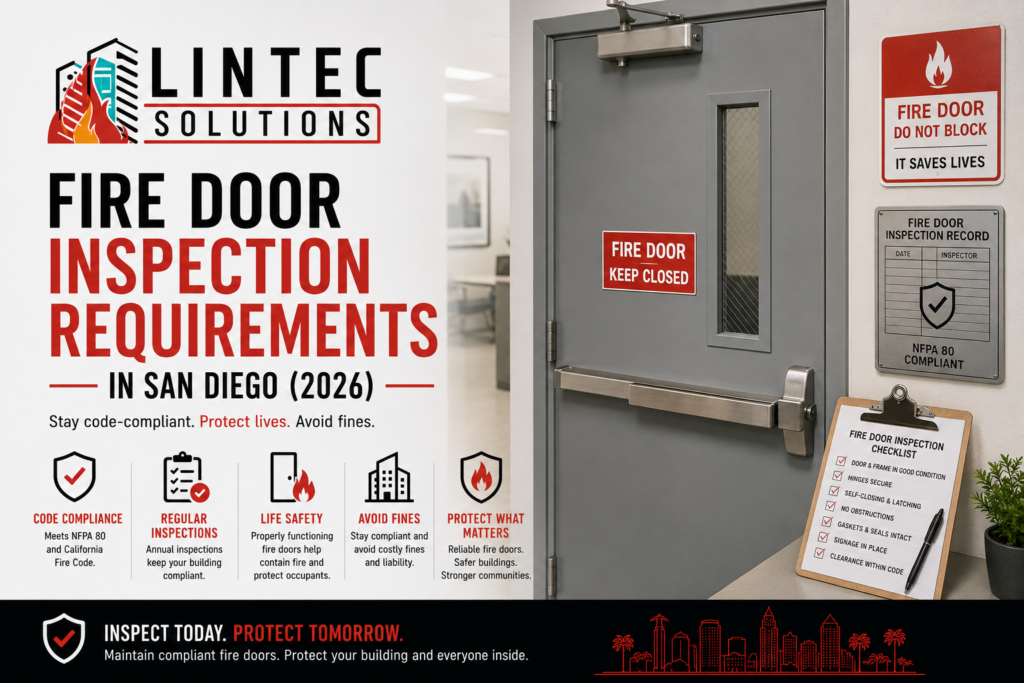
Fire Door Inspection Requirements in San Diego (2026)
Fire-rated doors are one of the most critical passive fire protection features in a commercial building, and they are also one of the most neglected. These doors are designed to contain fire and smoke within compartments, protect evacuation routes, and buy time for occupants to exit and firefighters to respond. When they fail, the compartmentalization strategy that the entire building’s fire protection system depends on falls apart.
Since 2013, NFPA 80 (Standard for Fire Doors and Other Opening Protectives) has required annual inspections of all fire door assemblies in commercial buildings. The San Diego Fire-Rescue Department checks for documentation of these inspections during their visits, and missing or outdated fire door inspection records are a common citation.
What Gets Inspected
A fire door inspection is not just checking whether the door closes. It is a detailed evaluation of every component of the fire door assembly to verify that it will perform as intended during a fire.
The inspector checks that the door, frame, and hardware bear the correct fire-rating label and that the label is legible. Doors without labels or with painted-over labels cannot be verified as fire-rated and may need to be replaced.
The door must close and latch fully from the full-open position without manual assistance. Self-closing devices (door closers) must pull the door completely shut so the latch engages. A fire door that swings closed but does not latch is not providing compartmentalization because smoke and heat will push past an unlatched door.
Clearances between the door and frame must fall within the tolerances specified in NFPA 80. Gaps that are too large allow smoke and flame to pass through the opening, defeating the purpose of the rated assembly. The maximum clearance along the top and sides is typically 1/8 inch, and the bottom clearance must not exceed 3/4 inch (or the clearance specified on the listing).
Glazing in fire doors must be fire-rated glass with intact labels. Standard glass is not acceptable in a fire-rated assembly and must be replaced if found.
Gasketing and edge seals, where required by the door’s listing, must be intact and in good condition. Missing or damaged gasketing allows smoke transmission through the door assembly.
Astragals (the overlapping strips on pairs of fire doors) must be present and functional. Coordinators on pairs of doors must operate correctly to ensure the doors close in the proper sequence.
Where Fire Doors Are Found
In a typical San Diego commercial building, fire-rated doors are located at stairwell enclosures, corridor separations, tenant demising walls, mechanical and electrical room entrances, elevator lobby separations, and any wall or partition that carries a fire-resistance rating.
In high-rise buildings, fire doors are particularly critical because they protect the stairwells that serve as the primary evacuation route and the corridors that connect to areas of refuge. In healthcare facilities, fire doors separate smoke compartments and are essential to the defend-in-place strategy.
Many fire doors in commercial buildings are held open with magnetic hold-open devices connected to the fire alarm system. When the fire alarm activates, the magnets release and the doors close automatically. These devices must be tested as part of both the fire door inspection and the annual fire alarm inspection to verify that the release and closure sequence functions properly.
Common Violations
The most frequent fire door violations found during San Diego fire inspections include doors that have been propped open with wedges, blocks, or other objects (defeating the self-closing function), missing or painted-over fire-rating labels, damaged or missing door closers, doors that do not fully latch, excessive gaps between door and frame due to building settlement or hardware wear, holes or penetrations in fire-rated doors where hardware was removed and not properly repaired, and non-rated hardware (standard hinges, knobs, or locksets) installed in place of fire-rated hardware.
Each of these conditions means the fire door assembly will not perform as designed during a fire. The fire marshal will cite each deficiency individually, and correction timelines are typically short because the risk is immediate.
Who Can Perform Fire Door Inspections
NFPA 80 requires that fire door inspections be performed by individuals with “knowledge and understanding” of the operating components of fire door assemblies. While the standard does not mandate a specific certification, many authorities having jurisdiction (including San Diego fire marshals) expect inspections to be performed by qualified professionals.
Coordinating fire door inspections with your fire alarm and fire protection system testing makes logistical sense. Your fire protection contractor can verify the operation of door hold-open devices, magnetic releases, and the fire alarm integration while a qualified door inspector evaluates the physical condition of the door assemblies.
Staying Compliant
Fire door inspections should be incorporated into your building’s overall inspection and maintenance program. Annual inspections with documented findings, along with prompt correction of any deficiencies, demonstrate to the San Diego Fire-Rescue Department that you are maintaining your building’s passive fire protection features to the same standard as your active systems.
If your building has not had a fire door inspection in the past twelve months, or if you are not sure whether your fire doors are in compliance, contact Lin Tec Fire Solutions to discuss coordinating a fire door assessment alongside your fire alarm and suppression system inspections.





Commercial Property ManagerSan Diego, CA