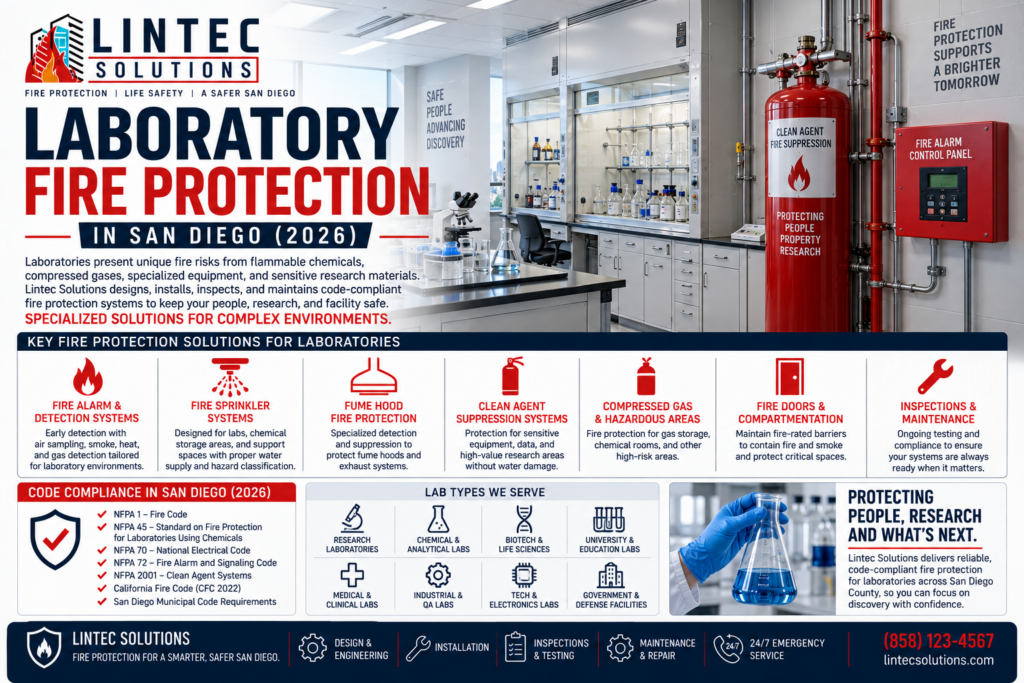
San Diego is one of the largest biotech and life sciences hubs in the country, with hundreds of research laboratories, pharmaceutical development facilities, and testing labs operating across the region. These environments house a concentration of fire hazards that standard commercial fire protection is not designed to handle: flammable and reactive chemicals, compressed gas cylinders, electrical equipment running around the clock, and operations that generate heat, sparks, and ignition sources as part of daily work.
The fire protection requirements for laboratories go beyond standard commercial building codes and pull in additional NFPA standards that specifically address the unique hazards of laboratory operations. If you own, manage, or lease laboratory space in San Diego, understanding these requirements is essential for both code compliance and the protection of your research investment.
Code Framework for Laboratories
Laboratory fire protection in San Diego is governed by the California Fire Code, the California Building Code, and several NFPA standards that apply specifically to laboratory environments.
NFPA 45 (Standard on Fire Protection for Laboratories Using Chemicals) is the primary reference for chemical laboratory fire protection. It establishes requirements for laboratory unit design, chemical storage quantities, ventilation, and fire protection systems based on the types and quantities of hazardous materials present.
NFPA 30 (Flammable and Combustible Liquids Code) applies to the storage and handling of flammable solvents, reagents, and other liquid chemicals used in laboratory operations.
NFPA 55 (Compressed Gases and Cryogenic Fluids Code) applies to the compressed gas cylinders and cryogenic systems common in research laboratories.
The California Fire Code also requires hazardous materials management plans (HMMPs) and hazardous materials inventory statements (HMISs) for facilities that store hazardous materials above threshold quantities. The San Diego Fire-Rescue Department reviews these documents as part of their inspection program and may require operational permits for specific hazardous material uses.
Chemical Storage and Classification
NFPA 45 classifies laboratories into four categories (A, B, C, and D) based on the quantities of flammable and combustible liquids used and stored in each laboratory unit. The classification determines the maximum allowable quantities per unit, the fire protection requirements for the space, and the construction requirements for the laboratory unit (fire-rated separations, number of exits, ventilation rates).
Class A laboratories use the largest quantities of flammable materials and face the most stringent fire protection requirements. Class D laboratories use minimal quantities and may have reduced requirements.
Within each laboratory unit, flammable liquids must be stored in approved flammable storage cabinets or safety cans when not in active use. The total quantity of flammable liquids outside of approved storage (on benchtops, in fume hoods) is limited based on the laboratory classification.
These storage requirements are checked during fire department inspections, and violations (excessive quantities on benchtops, flammable liquids stored in unapproved locations, cabinets without self-closing doors) are common citations.
Fire Alarm Systems for Laboratories
Laboratory fire alarm systems must address the specific detection challenges of the lab environment. Standard smoke detectors may generate frequent false alarms in laboratories where chemical vapors, aerosols, and particulates are routinely present. Detector selection must account for the specific airborne contaminants in each lab area.
Heat detectors or multi-criteria detectors may be more appropriate than smoke-only detection in certain laboratory zones. Fume hood areas may require specialized detection approaches because the high air velocities inside hoods dilute smoke and reduce detector sensitivity.
The fire alarm system must be integrated with the laboratory’s safety systems, including fume hood exhaust fans (which typically remain running during a fire alarm to prevent chemical vapor buildup rather than shutting down like standard HVAC systems), gas detection systems that monitor for hazardous gas leaks, and emergency gas shutoff valves for flammable gas supply lines.
All fire alarm test reports must be submitted through The Compliance Engine for facilities within the City of San Diego.
Suppression Systems for Laboratories
Most laboratories in San Diego require automatic fire sprinkler systems. The sprinkler design must account for the hazard classification of the laboratory based on the materials present and the storage arrangements.
Some laboratory areas may require specialized suppression beyond sprinklers. Chemical storage rooms with quantities exceeding certain thresholds may need enhanced sprinkler densities or supplemental suppression. Rooms with water-reactive chemicals require suppression systems that do not use water, which may include dry chemical or clean agent systems depending on the specific chemicals involved.
Server rooms and data storage areas within laboratory facilities that house research data and instrumentation controls benefit from clean agent suppression or pre-action sprinkler systems to protect sensitive equipment from water damage.
Fume Hoods and Ventilation
Fume hoods are the primary engineering control for containing chemical vapors in laboratories, and they have a direct relationship to fire protection. Fume hoods must maintain a minimum face velocity to contain vapors within the hood, and the exhaust system must be designed to prevent the accumulation of flammable vapors in the ductwork.
During a fire event, the decision of whether to shut down or continue running fume hood exhaust is a critical design consideration. Shutting down exhaust systems can allow chemical vapors to accumulate in the laboratory, creating an explosion risk. Continuing to run exhaust systems can feed oxygen to a fire or spread smoke through the ductwork. The fire protection design team must coordinate with the mechanical engineer to develop the correct response for each laboratory’s specific hazards.
Fire dampers in laboratory exhaust ductwork require special consideration because closing a damper in an exhaust duct that serves a fume hood can create a dangerous condition. NFPA 45 addresses these scenarios with specific provisions for damper use in laboratory exhaust systems.
Compressed Gas Safety
Research laboratories in San Diego commonly use compressed gas cylinders containing flammable gases (hydrogen, methane, acetylene), oxidizing gases (oxygen, nitrous oxide), inert gases (nitrogen, argon, helium), and toxic or corrosive gases (chlorine, ammonia, hydrogen sulfide).
The California Fire Code and NFPA 55 require that compressed gas cylinders be properly secured (chained or strapped to a wall or bench), stored in well-ventilated areas, separated by compatibility (flammable gases away from oxidizers), and limited in quantity per laboratory unit based on the gas type.
Gas detection systems may be required in areas where toxic or flammable gases are used or stored. These systems must be integrated with the fire alarm system to provide notification and initiate emergency ventilation when hazardous concentrations are detected.
Inspection and Maintenance
Laboratory fire protection systems require the same inspection and maintenance schedule as any commercial building, plus additional attention to the laboratory-specific systems. Fire extinguishers in laboratories must be rated for the specific hazards present (Class B for flammable liquids, Class D for combustible metals, Class K for cooking oils if a break room kitchen is present).
The fire department inspects laboratory facilities with particular attention to hazardous materials compliance, chemical storage quantities, and the condition of fire protection systems. Having current testing documentation and a well-organized hazardous materials inventory demonstrates proactive compliance.
If you manage a laboratory facility in San Diego and want to verify that your fire protection systems are properly designed for your specific operations and hazardous materials, contact Lin Tec Fire Solutions for an assessment tailored to your facility’s unique requirements.





Commercial Property ManagerSan Diego, CA