
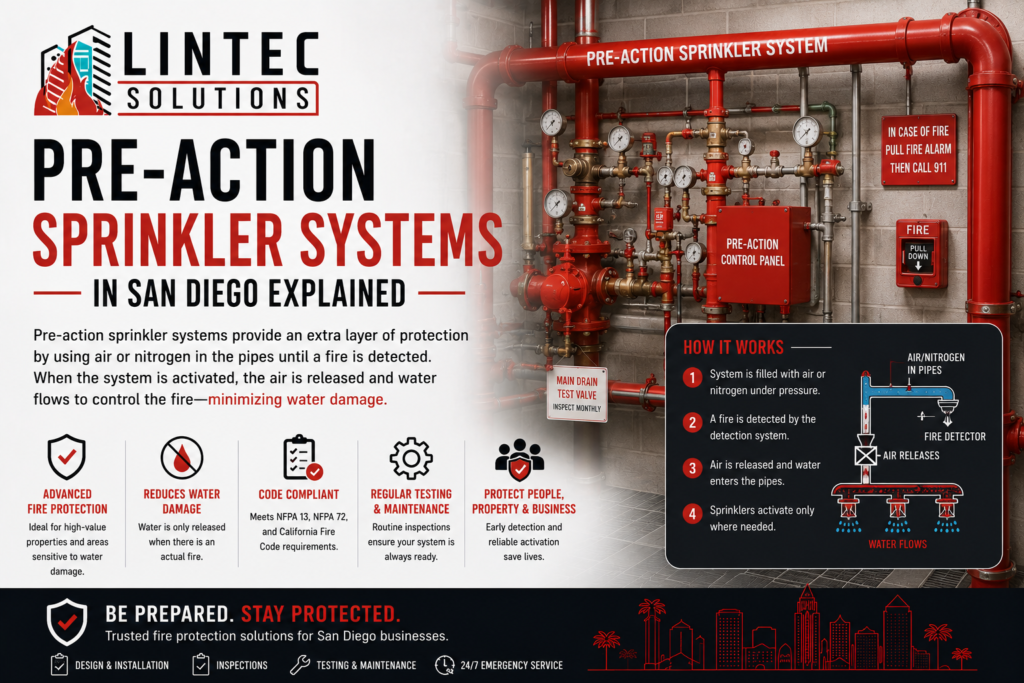
Pre-Action Sprinkler Systems in San Diego Explained
Standard wet pipe sprinkler systems are the workhorse of fire protection in most San Diego commercial buildings. But for facilities where accidental water discharge would cause significant damage, such as data centers, server rooms, museums, archives, telecom facilities, and high-value storage areas, a standard wet pipe system introduces a risk that many building owners are not willing to accept.
Pre-action sprinkler systems solve this problem by adding a secondary activation requirement before water enters the piping. This two-step process provides sprinkler protection while dramatically reducing the risk of accidental water release due to damaged piping, broken sprinkler heads, or other mechanical failures.
How Pre-Action Systems Work
In a wet pipe system, the piping is always filled with water. If a sprinkler head is accidentally broken (by a forklift, a ladder, or an impact from stored materials), water flows immediately. In a data center or server room, that accidental discharge can cause more damage than a small fire would.
A pre-action system keeps the piping dry under normal conditions. Water does not enter the piping until a separate detection event occurs. There are two main configurations.
Single interlock pre-action systems require one event before water fills the piping: the detection system (typically smoke detectors monitored by the fire alarm panel) must activate. Once the detection system confirms a fire condition, the pre-action valve opens and water fills the piping. Individual sprinkler heads then activate based on heat exposure, just like a wet pipe system.
Double interlock pre-action systems require two independent events: the detection system must activate AND a sprinkler head must open. Only when both conditions are met does the pre-action valve open to allow water flow. Double interlock systems provide the highest level of protection against accidental discharge and are commonly specified for data centers and other environments where even a small amount of water would cause significant damage.
In either configuration, the dry piping is supervised with compressed air or nitrogen. A pressure drop in the air supervisory system (indicating a pipe break or head failure) triggers a trouble alarm on the fire alarm panel but does not cause water to flow. This supervisory feature provides early warning of a mechanical problem without the consequence of water damage.
When Pre-Action Systems Are Required or Recommended
Pre-action systems are not required by the California Fire Code for specific occupancy types in the same way that sprinklers in general are required. Instead, they are specified when the building owner, architect, or fire protection designer determines that the risk of accidental water discharge warrants the additional cost and complexity.
The most common applications in San Diego include data centers and colocation facilities (often combined with clean agent suppression for the most critical spaces), server rooms and telecommunications infrastructure, museums, galleries, and archival storage facilities, cold storage and freezer facilities (where dry piping prevents freeze damage and the pre-action valve provides additional protection), and any high-value environment where water damage from an accidental sprinkler discharge would be catastrophic.
Design and Integration Considerations
Pre-action systems are more complex to design, install, and maintain than standard wet or dry pipe systems. The system requires a detection system (typically integrated with the building’s fire alarm system) to monitor the protected space and initiate the pre-action valve release, a pre-action valve assembly with electronic release mechanism, air or nitrogen supervisory piping with pressure monitoring, and programming in the fire alarm panel to coordinate detection, valve release, and alarm notification.
The air or nitrogen supervisory system is where nitrogen generators from ECS provide significant value for pre-action systems. Because the piping is dry under normal conditions, the supervisory gas composition directly affects internal corrosion. Using compressed air (21% oxygen) allows corrosion to develop on the interior pipe surfaces over time. Replacing the compressed air with 98% nitrogen eliminates this corrosion mechanism and extends the service life of the piping.
The integration between the detection system, fire alarm panel, and pre-action valve must be tested as a complete sequence during annual fire protection testing. This means activating the detection system, verifying that the pre-action valve opens on signal, confirming water flow through the piping, and verifying that all alarm and supervisory signals reach the monitoring station.
Maintenance Requirements
Pre-action systems require more maintenance attention than wet pipe systems because of the additional components involved. NFPA 25 establishes the testing schedule, which includes quarterly testing of the air supervisory system, annual trip testing of the pre-action valve, annual testing of the detection system integration, and five-year internal valve inspections.
The pre-action valve itself is a critical component. If it fails to open when the detection system activates, the sprinkler system will not have water available. If it opens without a detection signal, you have an unintended system fill that could lead to water discharge from a compromised head. Regular testing and maintenance of the valve assembly is essential.
All maintenance and test records must be submitted through The Compliance Engine for properties within the City of San Diego.
Is a Pre-Action System Right for Your Facility?
The decision to install a pre-action system comes down to a risk analysis. The additional cost (typically 30-50% more than a standard wet pipe system) must be weighed against the potential cost of accidental water damage to the assets being protected. For a data center with millions of dollars in hardware, the investment is easy to justify. For a standard office space, a wet pipe system is perfectly adequate.
If you are evaluating whether a pre-action system is appropriate for your San Diego facility, contact Lin Tec Fire Solutions for a design consultation that assesses your specific risk profile and recommends the right system type for your environment.





Commercial Property ManagerSan Diego, CA