Author: Lintech Solutions

  • Fire Safety Plans for San Diego Commercial Buildings

    Fire Safety Plans for San Diego Commercial Buildings

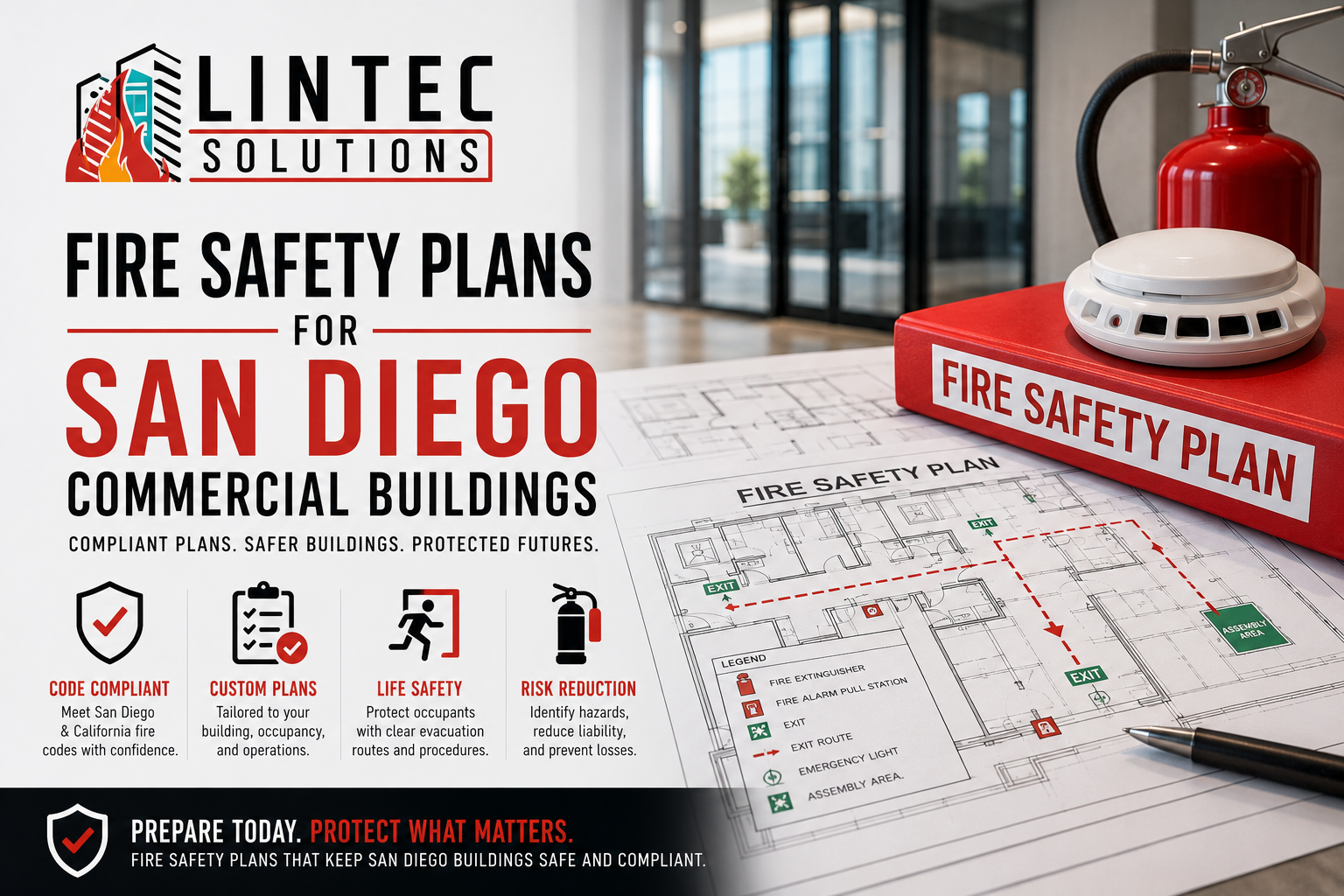
    A fire safety plan is not a document you create once and file away. It is the written operational framework that tells everyone in your building what to do when a fire occurs, who is responsible for what, and how your fire protection systems support the emergency response.


    The California Fire Code requires commercial buildings to maintain fire safety plans, and the San Diego Fire-Rescue Department reviews these plans during inspections. A building without a current fire safety plan is out of compliance, and a building with a plan that does not reflect its current layout, occupancy, or fire protection systems is nearly as bad.


    What a Fire Safety Plan Must Include


    A complete fire safety plan for a San Diego commercial building should cover several key areas.


    Building information includes the building address, number of floors, occupancy type, and a general description of the building’s use. For multi-tenant buildings, the plan should identify all tenant spaces and their respective occupancy types.


    Fire protection systems describes the fire alarm system type and location of the control panel, the sprinkler system type and main valve locations, any fire suppression systems (clean agent, kitchen hood, dry chemical) and their locations, fire extinguisher locations and types, and the fire alarm monitoring company and contact information.


    Evacuation procedures details the evacuation routes for each floor and area of the building, assembly point locations outside the building, procedures for assisting occupants who need help evacuating, and the roles and responsibilities of designated fire safety personnel.


    Emergency contacts lists the building owner or property manager, the fire protection contractor, the fire alarm monitoring company, and the local fire department non-emergency number.


    Maintenance schedule references the inspection and testing program for all fire protection systems in the building, including the contractor responsible and the testing frequency for each system.


    Who Is Responsible for the Plan


    The building owner is ultimately responsible for maintaining a current fire safety plan. For hotels, healthcare facilities, and schools, additional regulatory agencies may have their own fire safety planning requirements that go beyond the California Fire Code baseline.


    The plan must be updated whenever significant changes occur in the building, including changes in tenancy or occupancy type, fire alarm system upgrades or panel replacements, modifications to sprinkler or suppression systems, changes to evacuation routes or exit configurations, and changes in the fire protection contractor or monitoring provider.


    A fire safety plan that references a fire alarm panel that was replaced two years ago, or evacuation routes that no longer exist due to a renovation, is a plan that will not pass inspection.


    How the Plan Connects to Your Fire Protection Program


    The fire safety plan is not a standalone document. It is the connecting tissue between your fire protection systems, your building occupants, and your inspection and maintenance program.


    When the fire marshal inspects your building and reviews your plan, they cross-reference it against the actual conditions in the building. Is the fire alarm control panel where the plan says it is? Are the extinguishers in the locations shown on the plan? Do the evacuation routes match the current floor layout? Is the maintenance schedule documented and current?


    This is where having a coordinated fire protection contractor helps. Your contractor can provide the technical information needed for the fire protection systems section of the plan and update that information whenever system modifications are made.


    Fire Drills and Plan Testing


    Having a fire safety plan on paper is not enough. The plan needs to be practiced through regular fire drills. The California Fire Code requires fire drills for certain occupancy types, and even for buildings where drills are not strictly mandated, periodic evacuation exercises verify that the plan works in practice.


    Drill documentation should include the date and time of the drill, the number of occupants who participated, the total evacuation time, any issues identified (blocked exits, notification devices not heard in certain areas, confusion about assembly points), and corrective actions taken.


    This documentation should be maintained alongside your fire protection system test records and available during fire department inspections.


    Getting Your Plan in Order


    If your building does not have a current fire safety plan, or if the plan has not been updated to reflect recent changes, now is the time to address it. Your fire protection contractor can help you document the technical aspects of the plan, and your property management team can fill in the operational procedures.


    If you need help developing or updating a fire safety plan for your San Diego commercial building, contact Lin Tec Fire Solutions to discuss how we can support the fire protection systems portion of your plan and ensure it aligns with your actual building conditions.
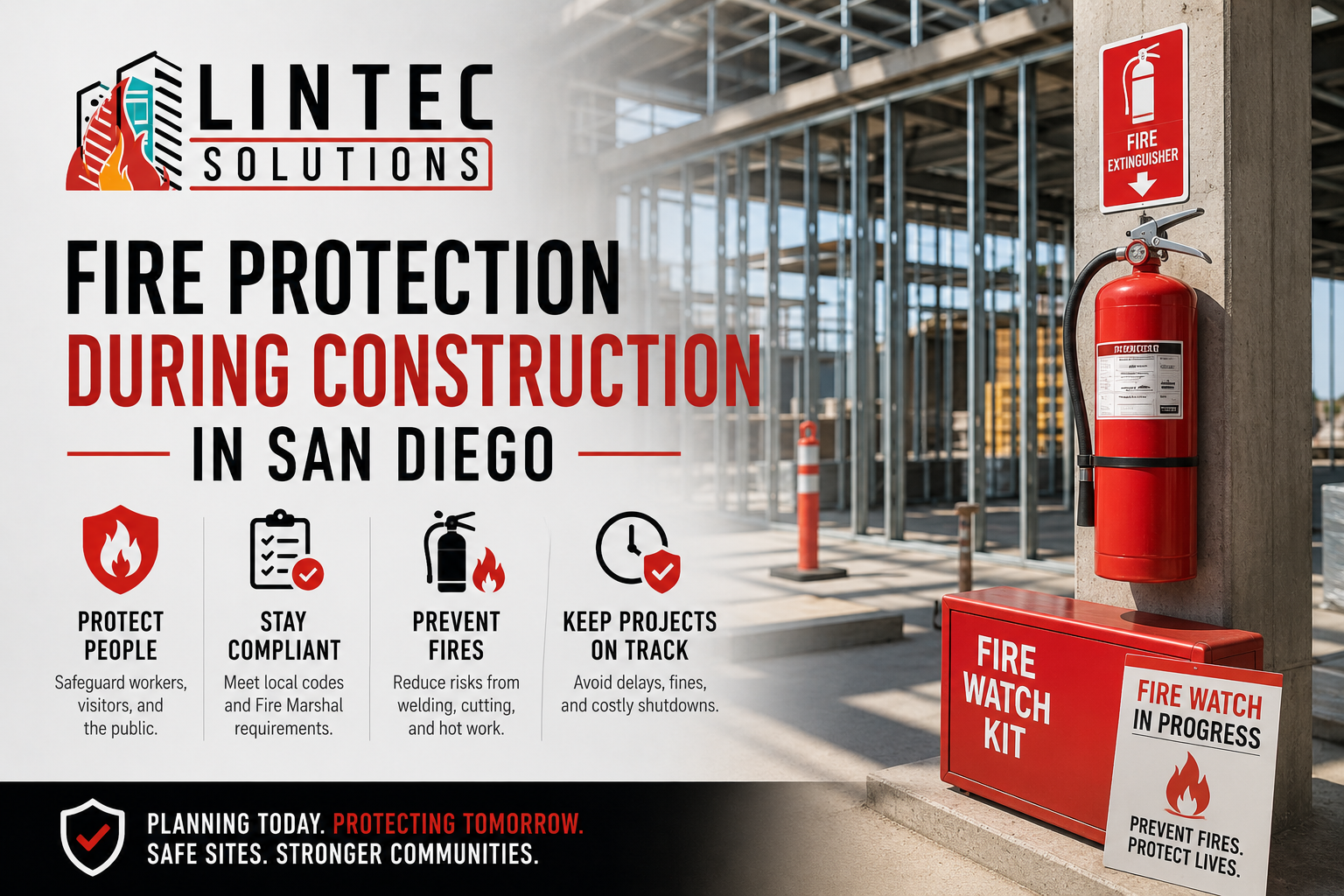

  • Fire Protection During Construction in San Diego

    Fire Protection During Construction in San Diego

    Construction sites are among the highest fire risk environments in San Diego. The combination of hot work (welding, cutting, soldering), temporary electrical systems, combustible building materials, and the absence of completed fire protection systems creates a fire exposure that the California Fire Code addresses with specific requirements.


    If you are a general contractor, project manager, or developer working on a commercial construction project in San Diego, fire protection is not something that kicks in when the building is finished. It is a requirement from the first day of construction through final occupancy.


    California Fire Code Requirements for Construction Sites


    The California Fire Code, Chapter 33 (Fire Safety During Construction and Demolition), establishes requirements for fire protection on construction sites. These requirements apply to all commercial construction projects in San Diego and are enforced by the San Diego Fire-Rescue Department.


    Key requirements include maintaining fire access roads for emergency vehicles throughout the construction phase, providing portable fire extinguishers at each floor level and in areas where hot work is performed, prohibiting open burning on construction sites within the city, storing combustible materials (lumber, insulation, packaging) in approved locations away from ignition sources, and maintaining temporary fire protection systems when portions of the building are occupied before final completion.


    Hot Work Permits and Fire Watch


    Hot work (any operation that produces sparks, open flames, or high heat) is one of the leading causes of construction fires. The California Fire Code requires a hot work permit program for all commercial construction projects.


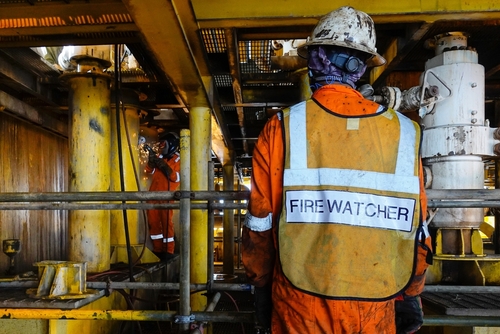
    Before any hot work begins, the area must be inspected for combustible materials within 35 feet of the work location. Combustible materials must be relocated or protected with fire-resistant covers. A fire watch must be maintained during the hot work and for a minimum of 30 minutes after the work is completed.


    The fire watch person must have no other duties during the watch period and must have a portable fire extinguisher immediately available. This is the same fire watch concept that applies to building system impairments, but in the construction context it is tied specifically to hot work operations.


    Documentation of hot work permits and fire watch logs must be maintained on site and available for inspection by the fire department at any time.


    Managing Fire Protection System Impairments


    On many San Diego construction projects, portions of the fire alarm and sprinkler systems are installed and activated before the entire building is complete. This is common in phased construction where parts of the building are occupied while other sections are still under construction.


    When construction activities require taking fire protection systems offline (shutting down sprinkler zones for tie-ins, disconnecting fire alarm devices during ceiling work, impairing suppression systems for modifications), the impairment must be managed in accordance with NFPA 25 and the California Fire Code.


    The building owner and contractor must notify the fire department and the fire alarm monitoring company of the impairment, implement a fire watch for the affected area, limit the duration of the impairment to the minimum time necessary, and restore the system and verify operation as soon as the work is complete.


    Poor management of impairments during construction is one of the most common fire code violations on San Diego construction sites. Planning the construction sequence to minimize impairment durations and coordinating with your fire protection contractor to restore systems quickly reduces both fire risk and regulatory exposure.


    Coordination with Fire Protection Installation


    Fire alarm and suppression system installation typically happens in phases during construction: rough-in during framing, device installation after ceilings and walls are finished, and final commissioning before occupancy.


    Working with a design-build fire protection contractor who is involved from the plan review phase ensures that the fire protection installation is coordinated with the overall construction schedule. This reduces conflicts with other trades, minimizes the need for impairments to completed systems, and keeps the fire alarm and suppression system installation on track for final inspection.


    Pre-Occupancy Requirements


    Before any portion of a San Diego building can be occupied, the fire protection systems serving that area must be fully installed, tested, and approved by the fire department. This includes the fire alarm system (all devices installed, programmed, and tested), the sprinkler system (all heads installed, piping pressure-tested, and water flow verified), any required suppression systems (fully charged and commissioned), fire extinguishers (properly placed and tagged), and emergency lighting and exit signage (operational on both normal and backup power).


    The fire department conducts a final inspection to verify all of these items before issuing the certificate of occupancy. Incomplete fire protection is one of the most common reasons certificates of occupancy are delayed on San Diego projects.


    If you are managing a construction project in San Diego and need a fire protection contractor who can coordinate installation with your construction schedule and ensure the systems are ready for final inspection, contact Lin Tec Fire Solutions to discuss your project timeline.

  • Kitchen Hood Cleaning Requirements in San Diego (2026)

    Kitchen Hood Cleaning Requirements in San Diego (2026)

    Your commercial kitchen’s exhaust hood and ductwork accumulate grease every single day. That grease is fuel, and if it is not removed on a documented schedule, it becomes the ignition source for a kitchen fire that your hood suppression system may not be able to control.


    San Diego fire code requires commercial kitchens to maintain a professional hood cleaning program, and the fire department checks for documentation during every inspection. This is not the same as the nightly wipe-down your kitchen staff performs. This is a full professional cleaning of the hood, filters, ductwork, and exhaust fan by a trained and certified hood cleaning company.


    What San Diego Fire Code Requires


    The California Fire Code adopts NFPA 96 (Standard on Ventilation Control and Fire Protection of Commercial Cooking Operations) as the governing standard for commercial kitchen exhaust systems. NFPA 96 establishes both the design requirements for hood and ductwork systems and the maintenance schedule for keeping them clean.


    The cleaning frequency depends on the type and volume of cooking being performed.


    Monthly cleaning is required for solid fuel cooking operations (wood-burning ovens, charbroilers, and similar equipment that produce heavy grease-laden vapors). High-volume operations like 24-hour restaurants, fast food kitchens, and facilities with heavy wok cooking also typically fall into this category.


    Quarterly cleaning is the standard for most commercial kitchens, including full-service restaurants, hotel kitchens, and cafeteria operations.


    Semi-annual cleaning applies to moderate-volume cooking operations such as day camps, churches, and seasonal kitchens.


    Annual cleaning applies to low-volume operations like churches that cook occasionally, day camps, and other facilities where cooking is infrequent.


    The fire marshal determines the appropriate cleaning frequency during the annual fire safety inspection based on the type of cooking equipment in use and the volume of cooking activity. If the inspector determines that your cleaning schedule does not match your actual cooking operations, you will be cited.


    What Professional Hood Cleaning Includes


    A proper hood cleaning goes far beyond wiping down the visible surfaces. The hood cleaning company must clean the interior of the hood plenum and all horizontal and vertical ductwork from the hood to the exhaust fan on the roof. They must clean or replace the grease filters, clean the exhaust fan blades and housing, and verify that the grease containment system (drip trays, grease cups) is functional and not overflowing.


    After cleaning, the company must apply a certification sticker to the hood showing the date of service, the company name, and the areas that were cleaned. This sticker is what the fire marshal looks for during inspections. Missing or expired stickers are an immediate citation.


    The cleaning must be performed by a company that is trained and equipped for commercial kitchen exhaust cleaning. NFPA 96 references the International Kitchen Exhaust Cleaning Association (IKECA) standards as the benchmark for proper cleaning procedures.


    The Connection to Your Suppression System


    Hood cleaning and kitchen fire suppression are directly connected. Your hood suppression system is designed to discharge wet chemical agent over the cooking surfaces and into the exhaust ductwork to suppress grease fires. If the ductwork is heavily coated with grease, the suppression agent may not be effective enough to control a fire that has ignited within the duct.


    Additionally, the suppression system’s fusible links and nozzles must remain clean and properly positioned. During a professional hood cleaning, the cleaning crew must be careful not to damage or displace suppression system components. After cleaning, the fire suppression contractor should verify that all nozzles are correctly aimed and that fusible links are intact.


    This is another reason why having a coordinated relationship between your hood cleaning company, your fire suppression contractor, and your fire alarm maintenance provider is important. All three services touch the same equipment, and they need to work together to keep everything functional and documented.


    What Happens When You Skip Cleaning


    Skipping a scheduled hood cleaning creates two problems. First, you accumulate grease that increases your fire risk. Second, you lose the documentation trail that proves compliance during inspections.


    When the San Diego Fire-Rescue Department inspects your restaurant and finds an expired or missing hood cleaning sticker, you receive a Notice of Violation. The correction timeline is typically short because the fire risk is considered immediate. In some cases, the fire marshal may require you to stop cooking operations until the cleaning is completed, which is the same outcome as a failed suppression system inspection.


    The cost of a professional hood cleaning is a fraction of the cost of a kitchen shutdown, a grease fire, or the insurance complications that follow a fire in a kitchen with lapsed maintenance.


    Staying on Schedule


    The simplest way to stay compliant is to contract with a reputable hood cleaning company for recurring service at the frequency that matches your cooking operations. Ask for documentation after every cleaning, including a signed service report and the certification sticker applied to the hood.


    Keep copies of all hood cleaning records alongside your fire suppression inspection reports, fire alarm test documentation, and fire extinguisher service records. When the fire marshal arrives, having all of this documentation organized and accessible is the fastest way to demonstrate compliance.


    If you need help coordinating your kitchen fire protection program, including suppression system maintenance, fire alarm integration, and inspection scheduling, contact Lin Tec Fire Solutions to discuss a comprehensive approach.

  • Reducing False Fire Alarms in San Diego Buildings

    Reducing False Fire Alarms in San Diego Buildings

    False fire alarms are more than a nuisance. In San Diego, they waste fire department resources, disrupt building operations, cause unnecessary evacuations, and can result in fines if they become a pattern. For hospitals and hotels, false alarms create additional risks by frightening patients and disturbing sleeping guests.


    The San Diego Fire-Rescue Department tracks false alarm frequency, and buildings with excessive false alarms may face increased scrutiny, additional inspections, and fee assessments. Reducing false alarms is not just about avoiding fines. It is about maintaining the credibility of your fire alarm system so that when a real alarm occurs, occupants take it seriously instead of assuming it is another false activation.


    The Most Common Causes of False Fire Alarms


    Understanding what triggers false alarms is the first step toward eliminating them. In San Diego commercial buildings, the most frequent causes fall into a few categories.


    Cooking and steam. Smoke detectors located too close to kitchens, break rooms, or areas where steam is generated (laundry rooms, cleaning closets, shower facilities) are triggered by airborne particles that are not fire-related. This is especially common in restaurant and hotel environments where cooking activity is continuous.


    Dust and construction debris. Renovation projects generate airborne dust that enters smoke detectors and triggers alarms. This is a frequent problem in multi-tenant buildings where one tenant is under construction while adjacent spaces are occupied. Detectors in or near construction zones should be covered or temporarily removed and replaced after the work is complete (with fire watch coverage during the impairment period).


    HVAC issues. Duct detectors can be triggered by unusual airflow patterns, temperature fluctuations, or debris in the ductwork. Smoke detectors located directly in the path of HVAC supply air can be triggered by air velocity pushing particles across the sensing chamber.


    Aging or dirty detectors. Smoke detectors have a sensitivity range that can drift over time as the sensing chamber accumulates dust and contamination. NFPA 72 requires sensitivity testing within the first year of installation and every two years after that. Detectors that have drifted outside their listed range must be cleaned or replaced.


    Improper detector selection. Different environments require different detection technologies. Photoelectric detectors are better suited for areas prone to smoldering fire conditions, while ionization detectors are more responsive to fast-flaming fires. Using the wrong detector type for the environment increases false alarm risk.


    How to Fix the Problem


    The solution to false alarms is not to reduce the sensitivity of your fire alarm system or disconnect problem devices. Both approaches create gaps in your fire protection coverage and put you out of compliance with San Diego fire code.


    Instead, the approach should be systematic. Start with a false alarm analysis. Your fire alarm contractor should review the alarm history log on your fire alarm control panel to identify which devices are generating false activations, the time of day and conditions when the alarms occur, and whether there is a pattern tied to specific activities (cooking, cleaning, HVAC cycling).


    From there, the contractor can recommend targeted solutions. Relocating detectors away from cooking or steam sources, replacing ionization detectors with photoelectric models in areas prone to aerosol triggers, upgrading to multi-criteria detectors that evaluate multiple conditions before activating, installing beam detectors or air-sampling detection in high-ceiling spaces where point detectors are problematic, and adding HVAC shutdown interlocks so that duct detectors are not triggered by normal system operation.


    The Role of Regular Maintenance


    Many false alarm problems are preventable through routine inspection and maintenance. When detectors are cleaned during regular service visits, sensitivity drift is caught during testing, and environmental changes in the building are evaluated against the detector layout, false alarms decrease significantly.


    A comprehensive fire alarm testing program includes sensitivity verification for every smoke detector on schedule. When a detector is found to be outside its listed range, it gets cleaned or replaced before it has the chance to generate a false alarm.


    Working with the Fire Department


    If your San Diego building has a history of false alarms, it is worth having a proactive conversation with the San Diego Fire-Rescue Department about the steps you are taking to address the issue. Demonstrating that you have identified the causes and engaged a licensed fire protection contractor to implement solutions shows good faith and may help avoid escalating fees or enforcement actions.


    If your building is experiencing frequent false fire alarms and you want a systematic approach to identifying and fixing the root causes, contact Lin Tec Fire Solutions for an alarm history analysis and a plan to reduce nuisance activations without compromising your fire protection coverage.

  • Stop Sprinkler Pipe Corrosion in San Diego with Nitrogen

    Stop Sprinkler Pipe Corrosion in San Diego with Nitrogen

    If your San Diego commercial building has a fire sprinkler system that is more than a few years old, there is a good chance corrosion is already eating away at the inside of the piping. You may not know about it until a pinhole leak causes water damage to a tenant space, or until an internal pipe inspection reveals that your system’s hydraulic performance has been compromised by buildup and blockages.

    Sprinkler pipe corrosion is one of the most expensive and disruptive problems a building owner can face. The good news is that it is also one of the most preventable.

    What Causes Sprinkler Pipe Corrosion

    The primary driver of corrosion in fire sprinkler systems is oxygen. In wet pipe systems, trapped air pockets expose the interior pipe surface to both water and oxygen, creating the conditions for oxidation corrosion. Every time the system is drained and refilled (for testing, repairs, or modifications), fresh oxygen is introduced into the piping.

    In dry pipe and pre-action systems, the problem is even more severe. These systems use compressed air to maintain supervisory pressure. That compressed air is approximately 21% oxygen. Every time the air compressor cycles to maintain pressure (which happens more frequently as leaks develop), more oxygen enters the system. The oxygen reacts with the steel pipe, producing corrosion that accelerates over time in a destructive cycle: corrosion causes leaks, leaks cause the compressor to run more, more compressor cycles introduce more oxygen, and the corrosion accelerates further.

    MIC: The Biological Threat Inside Your Pipes

    Beyond oxygen corrosion, fire sprinkler systems are also vulnerable to microbiologically influenced corrosion, commonly known as MIC. This is a form of corrosion driven by bacteria and microorganisms that colonize the interior surfaces of sprinkler piping.

    These microbes form biofilms (also called slime layers) on the pipe walls. The colonies produce localized chemical environments that are highly acidic, creating concentrated pitting corrosion that can eat through pipe walls far faster than general oxidation alone. The byproducts of MIC include tubercles and nodules that build up inside the pipe, reducing flow capacity and potentially clogging sprinkler heads.

    NFPA 13 (Standard for the Installation of Sprinkler Systems) requires that water supplies and environmental conditions be evaluated for the existence of microbes that contribute to MIC. NFPA 25 (Standard for the Inspection, Testing, and Maintenance of Water-Based Fire Protection Systems) requires that any tubercles or slime found during internal pipe inspections be tested for MIC immediately.

    MIC does not only affect old systems. It can develop in systems that are only a few years old, particularly when the water supply carries elevated bacterial loads or when the system’s piping retains organic debris (pipe joint compound, cutting oils, dirt) from the original installation.

    Why Traditional Solutions Fall Short

    For years, the industry’s primary response to sprinkler pipe corrosion was reactive: find leaks, patch or replace the affected sections, and move on. Some facilities attempted to control MIC with chemical biocide treatments, but biocides must be continually rotated because the bacteria can develop resistance over time. Biocide programs also require ongoing chemical handling, monitoring, and cost.

    None of these approaches address the root cause of the problem. As long as oxygen continues to enter the system, corrosion will continue. Patching leaks without eliminating the oxygen source is like bailing water out of a boat without plugging the hole.

    The Nitrogen Generator Solution

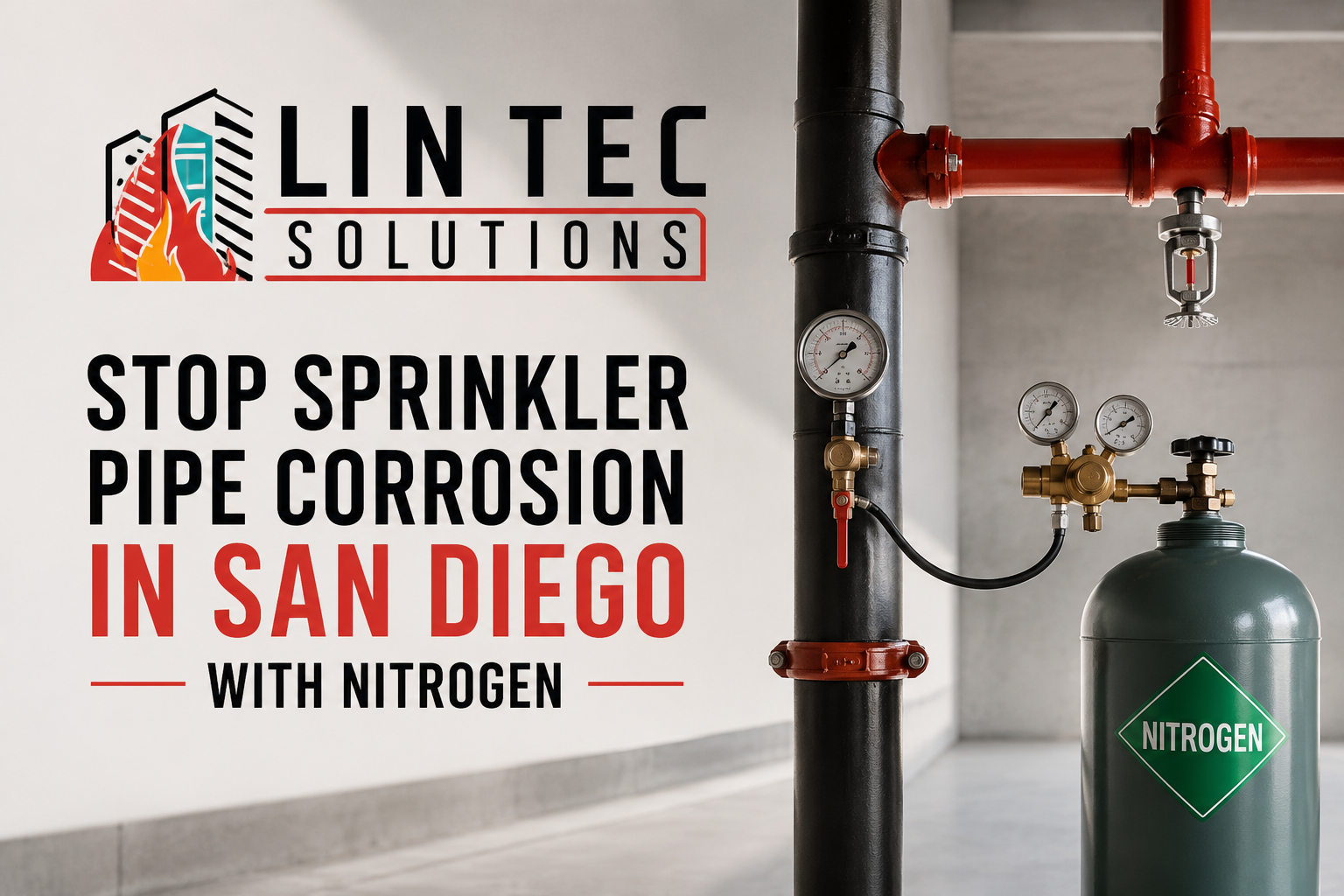
    The most effective way to stop sprinkler pipe corrosion is to eliminate the oxygen that causes it. Nitrogen generator systems do exactly that by replacing the compressed air in dry pipe and pre-action sprinkler systems with 98% pure nitrogen gas.

    Because nitrogen is inert (it does not react with steel), replacing oxygen with nitrogen stops the oxidation process and breaks the corrosion cycle. Research has shown that nitrogen inerting can extend the service life of fire sprinkler piping by up to 5.3 times compared to systems supervised with compressed air.

    Lin Tec Fire Solutions is an authorized dealer for Engineered Corrosion Solutions (ECS), the company that pioneered nitrogen generator technology for fire sprinkler systems. ECS nitrogen generators are both FM Approved and UL 508A Listed, making them the industry standard for sprinkler corrosion control.

    How ECS Nitrogen Generators Work

    An ECS nitrogen generator takes compressed air (which is naturally 78% nitrogen, 21% oxygen, and trace gases) and separates the nitrogen from the oxygen using membrane technology. The result is 98%+ pure nitrogen that is fed into the sprinkler system as the supervisory gas.

    The system includes automatic venting devices (such as the ECS Protector Automatic Vent or the Dry SMART Vent) that purge oxygen-rich gas from the sprinkler piping during the initial inerting process and after any system trip or drain event. Once the piping reaches the target nitrogen purity, the vents close automatically and the system maintains its inert atmosphere.

    ECS offers several generator configurations to match different building and system sizes. Wall-mount and skid-mount generators handle systems up to approximately 3,200 gallons of sprinkler volume. Stand-alone generators paired with separate air compressors handle larger systems up to 22,500 gallons, making them ideal for large warehouses, parking garages, data centers, and campus environments.

    ECS also offers corrosion monitoring devices that allow you to track conditions inside the piping and verify that the nitrogen inerting program is working. This monitoring capability satisfies the corrosion assessment requirements in NFPA 25 and gives you documented proof that your system is being actively protected.

    Which San Diego Buildings Benefit Most

    Any building with a dry pipe or pre-action fire sprinkler system is a candidate for a nitrogen generator. In San Diego, the most common applications include parking garages (unheated spaces requiring dry pipe systems), cold storage and refrigerated facilities, loading docks and unheated warehouse bays, data centers with pre-action sprinkler protection, and any building experiencing recurring pinhole leaks in sprinkler piping.

    Wet pipe systems also benefit from ECS corrosion control products. ECS offers solutions for wet pipe applications that address trapped oxygen and reduce corrosion in systems where standing water creates ongoing oxidation.

    If your building has experienced unexplained sprinkler leaks, if your internal pipe inspections have revealed corrosion or buildup, or if you are installing a new dry pipe or pre-action system and want to protect your investment from day one, a nitrogen generator is the most effective long-term solution available.

    Getting Started

    As an authorized ECS dealer, Lin Tec Fire Solutions can evaluate your existing sprinkler system, recommend the right nitrogen generator configuration for your building, and handle the full installation and commissioning process. We also provide ongoing inspection and maintenance for the nitrogen generator system and the fire sprinkler system it protects.

    If you want to stop sprinkler pipe corrosion before it causes costly leaks and system failures, contact us for an assessment and find out how nitrogen inerting can protect your San Diego building’s fire protection investment.

  • High-Rise Fire Alarm Requirements in San Diego (2026)

    High-Rise Fire Alarm Requirements in San Diego (2026)

    San Diego has more than 200 high-rise buildings, and every one of them is subject to fire alarm requirements that go well beyond what a standard commercial property faces. The San Diego Fire-Rescue Department conducts annual inspections on all high-rise buildings, and the systems inside these buildings must meet a higher standard of performance, redundancy, and integration.

    If you own or manage a high-rise in San Diego, your fire alarm system is not just a code requirement. It is the primary life safety system for every occupant above the reach of fire department ladders.

    What Makes High-Rise Fire Alarm Requirements Different

    The California Fire Code defines a high-rise building as any structure where the highest occupied floor is more than 75 feet above the lowest level of fire department vehicle access. At that height, evacuation becomes more complex, fire department access is limited, and the fire alarm system takes on a central role in emergency management.

    High-rise fire alarm systems in San Diego must include several features that are not required in standard commercial buildings. Voice evacuation systems are mandatory so that occupants receive spoken instructions rather than just a generic horn tone. This allows for phased evacuation, where the floors closest to the fire are evacuated first while other floors shelter in place until directed to move.

    A fire command center is required, typically located in the main lobby, where the fire department can take control of building systems during an emergency. The fire alarm control panel, building communication systems, elevator controls, HVAC overrides, and stairwell pressurization controls must all be accessible from this single location.

    Smoke control systems are required to prevent smoke from spreading through stairwells and elevator shafts. The fire alarm system must be integrated with these smoke control systems to activate them automatically upon detection.

    Two-way communication systems must be installed in stairwells, elevators, and areas of refuge so that occupants can communicate with the fire command center during an emergency.

    These requirements are detailed in NFPA 72, the California Fire Code, and San Diego’s local amendments. A fire alarm contractor working on high-rise projects must be thoroughly familiar with all three.

    The Unique Challenges of High-Rise Fire Alarm Design

    Designing a fire alarm system for a high-rise is fundamentally different from designing one for a single-story commercial building. The vertical nature of the structure creates challenges with wiring distances, signal timing, and device coordination across dozens of floors.

    Addressable fire alarm systems are the standard for high-rise applications because they allow the control panel to identify the exact device and location of an alarm activation. In a 30-story building, knowing that the alarm came from a specific smoke detector on the 17th floor rather than just “somewhere in Zone 4” is the difference between a targeted response and confusion.

    The system must also handle a large number of devices without exceeding loop capacity or creating communication delays. This requires careful system design and engineering that accounts for the building’s current configuration and anticipated future changes.

    Power supply requirements are stricter for high-rise systems. NFPA 72 requires that fire alarm systems operate on backup power for 24 hours in standby mode and then an additional 5 minutes in full alarm mode. For high-rise systems with voice evacuation, that alarm mode requirement extends to 60 minutes. Battery calculations and generator integration must be designed to meet these extended requirements.

    Annual Inspections Are Not Optional

    The City of San Diego requires annual fire alarm inspections for all high-rise buildings, and these inspections are among the most thorough in the city’s program. The fire department’s Community Risk Reduction Division dedicates specific resources to the high-rise inspection program because of the elevated risk these buildings represent.

    During a high-rise inspection, every component of the fire alarm system is tested, including all detection devices, notification appliances, voice evacuation speakers, two-way communication stations, elevator recall sequences, HVAC shutdown sequences, and smoke control integration.

    All test reports must be submitted through The Compliance Engine, and the fire department cross-references these reports with their own inspection findings. If your contractor’s testing report does not align with what the fire marshal observes during the department inspection, expect follow-up questions and potential violations.

    Keeping Your High-Rise Compliant

    High-rise fire alarm compliance requires more than just passing the annual inspection. It requires a proactive maintenance and inspection program that keeps the system in peak condition year-round.

    Smoke detector sensitivity testing must be performed within the first year of installation and every other year after that. Battery load tests must verify that backup power meets the extended requirements for voice evacuation systems. Device inventory records must be accurate and current.

    For older high-rise buildings in San Diego with fire alarm systems that were installed under previous code editions, a system evaluation may reveal that certain components no longer meet current requirements. Upgrading an existing high-rise fire alarm system is a complex project, but it is far better to plan and execute an upgrade on your timeline than to be forced into one by a failed inspection.

    If you manage a high-rise in San Diego and want to confirm your fire alarm system meets current code requirements, schedule a consultation with a contractor who has direct experience with high-rise fire alarm design, installation, and inspection.

  • Fire Protection Design-Build in San Diego Explained

    Fire Protection Design-Build in San Diego Explained

    If you are a general contractor, architect, or developer working on a commercial project in San Diego, fire protection is one of those line items that can either run smoothly in the background or become the reason your project falls behind schedule.

    The difference usually comes down to how the fire protection scope is structured. When design and installation are handled by separate companies, miscommunication and finger-pointing are almost inevitable. When they are handled by a single design-build fire protection contractor, accountability is clear and the process moves faster.

    What Design-Build Means in Fire Protection

    In a traditional project delivery model, the building’s architect or fire protection engineer produces the fire alarm and suppression system design. Then a separate contractor bids on the installation based on those drawings. If the design has issues or does not account for field conditions, the installing contractor submits RFIs, the engineer revises the drawings, and the schedule slips.

    In a design-build model, one fire protection contractor handles both the system design and the installation. That contractor takes responsibility for producing code-compliant drawings, obtaining permits, coordinating with the authority having jurisdiction (AHJ), installing the system, and commissioning it for final inspection.

    This model works particularly well for fire alarm systems and fire suppression systems because the contractor designing the system is the same team that will install it. They design for constructability from the start rather than producing theoretical drawings that require field modification.

    Why San Diego Projects Benefit from Design-Build

    San Diego has specific local code requirements and filing processes that out-of-area contractors sometimes struggle with. The requirement to submit fire protection test reports through The Compliance Engine, the local amendments to the California Fire Code, and the particular expectations of San Diego fire marshals during final inspection all create a learning curve for contractors who do not regularly work in this jurisdiction.

    A design-build fire protection contractor based in San Diego brings local code knowledge into the design phase from day one. They know which system configurations the local AHJ will approve, which submittal formats are expected, and how to coordinate fire department inspections without holding up your certificate of occupancy.

    This local expertise matters just as much as technical capability. A system that meets NFPA standards but does not satisfy the local fire marshal’s interpretation of those standards will still fail inspection. Working with a consulting and design team with San Diego experience eliminates that risk.

    How the Process Works

    A typical design-build fire protection engagement starts with a project kickoff meeting where the fire protection contractor reviews architectural drawings, understands the building’s occupancy type and layout, and identifies the fire protection requirements that apply.

    From there, the contractor produces fire alarm and/or suppression system design drawings, completes hydraulic calculations (for sprinkler and suppression systems), prepares submittal packages for the AHJ, and coordinates with the general contractor on installation sequencing.

    One of the biggest advantages of this model is the submittal package preparation. Lin Tec Fire Solutions prepares complete submittals that accompany fire alarm design shop drawings and fire suppression design drawings for transmittal to the customer, engineer, or AHJ. This eliminates the back-and-forth that typically happens when submittals are incomplete or poorly organized.

    During construction, the fire protection contractor coordinates with electrical, mechanical, and other trades to ensure devices are installed at the correct heights and locations, wiring pathways are clear, and suppression piping does not conflict with other building systems.

    After installation, the contractor performs commissioning and acceptance testing, submits documentation to the fire department, and supports the final inspection.

    When to Bring in Your Fire Protection Contractor

    The most common mistake on San Diego construction projects is bringing the fire protection contractor in too late. If the fire alarm and suppression design is not started until the building is framed and drywalled, you lose the ability to run conduit through walls, coordinate device locations with ceiling layouts, and resolve conflicts with other trades before they become change orders.

    The ideal time to engage your fire protection design-build contractor is during the design development phase, before construction documents are finalized. This gives the contractor time to produce a coordinated fire protection design that integrates with the rest of the building’s systems rather than being forced to work around them.

    If you are a GC or developer working on a commercial project in San Diego and need a fire protection partner who can handle the full scope from design through commissioning, start the conversation early and avoid the delays that come from a fragmented approach.

  • Fire Watch Requirements in San Diego: When and Why

    Fire Watch Requirements in San Diego: When and Why

    A fire watch is one of those things most San Diego property managers have never heard of until they need one. And by that point, they are usually scrambling because their fire alarm or sprinkler system just went out of service and the fire department is telling them they need someone physically patrolling their building 24 hours a day until the system is restored.

    Understanding when a fire watch is required, what it involves, and how to avoid needing one in the first place can save you thousands of dollars and a significant amount of stress.

    What Is a Fire Watch?

    A fire watch is a continuous patrol performed by trained personnel whose sole duty is to monitor a building for fire hazards when the fire protection systems are impaired or out of service. The person on fire watch must have no other responsibilities during their shift. Their job is to walk the building, watch for signs of fire, and immediately notify the fire department and building occupants if a hazard is detected.

    The City of San Diego’s policy on disrupted fire protection systems requires a fire watch whenever a fire alarm system, sprinkler system, or other required fire protection system is taken out of service for more than a specified period. The fire watch must continue around the clock until the system is fully restored and tested.

    This is not a guideline or a suggestion. It is an enforceable requirement under the California Fire Code, and the San Diego Fire-Rescue Department actively monitors compliance.

    What Triggers a Fire Watch in San Diego?

    The most common situations that trigger a fire watch requirement include a fire alarm system that has gone into a full trouble or supervisory condition and cannot be restored quickly, a sprinkler system that has been shut down for repairs or modifications, a fire suppression system that has been impaired (such as a discharged clean agent system or a kitchen hood system undergoing maintenance), and construction activities that temporarily disable fire protection in occupied areas.

    In each of these scenarios, the building owner or manager is required to notify the San Diego Fire-Rescue Department of the impairment, implement a fire watch, and maintain the fire watch until the system is back in full operation.

    The notification to the fire department is important. If they discover that your system is impaired and you have not reported it or implemented a fire watch, you face violations and potential fines on top of the cost of the fire watch itself.

    What a Fire Watch Costs

    Fire watch services are typically billed on an hourly basis, and the rates add up quickly because coverage must be continuous. A 24-hour fire watch running for several days can easily cost several thousand dollars, and that expense comes on top of whatever repair costs are needed to restore the impaired system.

    This is why proactive maintenance is so much more cost-effective than reactive repair. A fire alarm panel that receives regular service and has minor issues resolved promptly is far less likely to suffer a catastrophic failure that takes the entire system offline and triggers a fire watch requirement.

    Similarly, keeping your fire suppression systems on a documented inspection schedule means that low cylinder pressures, corroded piping, and aging components get addressed before they cause a full system shutdown.

    How to Minimize Fire Watch Risk

    The best way to avoid a fire watch is to keep your fire protection systems properly maintained so they do not go out of service unexpectedly.

    Work with a licensed fire protection contractor who provides scheduled inspections, responds quickly to trouble conditions, and has the parts and expertise to make repairs without extended downtime.

    When planned impairments are necessary (for example, during a fire alarm panel replacement or a building renovation), coordinate with your fire protection contractor to minimize the duration of the impairment and plan the fire watch coverage in advance so you are not scrambling to find a provider at the last minute.

    For construction projects, include fire watch planning in your pre-construction meetings. Your fire protection design-build contractor can help you phase the work to maintain partial protection during construction and reduce the total fire watch hours required.

    If you are currently dealing with a system impairment or want to evaluate your building’s fire watch risk, contact a licensed fire protection contractor who can assess your systems and recommend a maintenance plan that keeps them operational.

  • Fire Alarm Monitoring in San Diego: What Businesses Need

    Fire Alarm Monitoring in San Diego: What Businesses Need

    A fire alarm system that is not monitored is a fire alarm system that only protects the people who happen to be in the building when it activates. If nobody is there at 2 AM on a Saturday when a fire starts, nobody calls the fire department. The alarm sounds in an empty building, and the fire burns until someone happens to notice.

    That is why the California Fire Code and San Diego local amendments require fire alarm monitoring for most commercial occupancies. The system must communicate with a listed monitoring station that can dispatch emergency services when an alarm is received.

    How Fire Alarm Monitoring Works

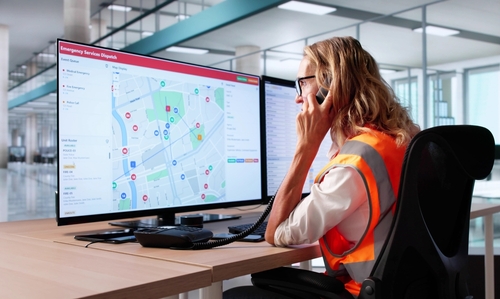
    When a fire alarm system detects a fire condition (smoke, heat, or a manual pull station activation), the control panel sends a signal to a supervising station, also called a central monitoring station. That station receives the signal, identifies the building and the type of alarm, and contacts the local fire department to dispatch a response.

    The same communication pathway also transmits supervisory and trouble signals. If your fire alarm panel loses AC power, has a ground fault, or experiences a device trouble condition, the monitoring station receives that signal and can notify you or your fire protection contractor so the issue can be addressed before it becomes a full system failure.

    This supervisory monitoring is what separates a properly maintained system from one that quietly deteriorates until it can no longer function during an emergency.

    Monitoring Communication Pathways

    The method your fire alarm system uses to communicate with the monitoring station matters. San Diego fire marshals pay attention to the communication pathway during inspections, and not all methods are equal in terms of reliability and code compliance.

    Traditional phone lines (POTS) were the standard for decades, but telecom companies have been phasing them out. If your building still relies on a copper phone line for fire alarm monitoring, you may be on borrowed time. When that line is discontinued, your system loses its communication pathway entirely, and you are out of compliance.

    Cellular communicators use the cellular network to transmit signals. They are reliable, relatively easy to install, and work well as a primary or secondary path. Many San Diego buildings have transitioned to cellular monitoring as phone lines have been decommissioned.

    IP-based communicators use your building’s internet connection. They are fast and cost-effective, but they depend on your network infrastructure being operational. Power outages that take down your router also take down your communication path unless battery backup is provided for the network equipment.

    Dual-path monitoring uses two independent communication methods (typically cellular and IP) to provide redundancy. If one path fails, the other continues transmitting. NFPA 72 and the California Fire Code may require dual-path monitoring for certain occupancy types, particularly high-rise buildings and high-risk facilities.

    Your fire alarm contractor can evaluate your current communication pathway and recommend upgrades if your existing method is at risk of becoming obsolete or does not meet current code requirements.

    What San Diego Code Requires

    The San Diego Fire-Rescue Department requires fire alarm systems in most commercial occupancies to be monitored by a listed central station that meets the requirements of NFPA 72. The monitoring company must be listed by a nationally recognized testing laboratory (such as UL or FM), and the communication pathway must be supervised so that any interruption in signal transmission triggers a trouble notification.

    All monitoring and fire alarm test records must be submitted through The Compliance Engine. During a fire department inspection, the marshal will verify that your system is actively monitored, that the communication pathway is functional, and that your monitoring records are current.

    If your system is not monitored, or if the monitoring pathway has failed and not been restored, you are in violation of the California Fire Code. Depending on the circumstances, this could trigger a fire watch requirement until monitoring is restored.

    Choosing a Monitoring Provider

    Not all monitoring stations provide the same level of service. When evaluating monitoring providers for a San Diego commercial property, confirm that the station is UL or FM listed, that they offer the communication pathway your building requires (cellular, IP, or dual-path), that they have experience handling fire alarm signals (not just security monitoring), and that they will coordinate with your fire protection contractor for trouble signal response.

    Some fire protection contractors, including Lin Tec Fire Solutions, can coordinate monitoring as part of a comprehensive fire alarm design, installation, and maintenance package. Having a single point of contact for your system hardware, monitoring, and ongoing inspection and maintenance simplifies compliance and ensures that all components of your fire alarm program work together.

    If you are not sure whether your current monitoring setup meets San Diego code requirements, or if you have received notice that your phone line is being decommissioned, reach out for an evaluation before the gap in monitoring creates a compliance problem.

  • When to Replace Your Fire Alarm Panel in San Diego

    When to Replace Your Fire Alarm Panel in San Diego

    Every fire alarm system has a brain, and that brain is the fire alarm control panel. It receives signals from every detector, pull station, and monitoring device in the building. It processes those signals, activates the appropriate notification appliances, communicates with the monitoring station, and provides the information firefighters need when they arrive.

    When that panel reaches the end of its useful life, the entire fire alarm system becomes unreliable. And in San Diego, an unreliable fire alarm system is a compliance problem, a liability exposure, and a safety risk all at once.

    Signs Your Fire Alarm Panel Needs Replacing

    Fire alarm panels do not last forever. Most manufacturers support their panels for 15 to 25 years, after which replacement parts become unavailable and software updates stop. Here are the most common indicators that your panel is approaching or past its useful life.

    Frequent trouble conditions. If your panel regularly displays trouble signals that your contractor resolves only to have them return days or weeks later, the panel’s internal components may be degrading. Intermittent faults that cannot be traced to specific field devices usually point back to the panel itself.

    Discontinued manufacturer support. When the manufacturer stops producing replacement boards, power supplies, and communication modules for your panel model, your fire protection contractor has to source parts from secondary markets or adapt non-original components. This introduces reliability risks and can complicate your annual fire alarm inspection.

    Incompatibility with current devices. Newer smoke detectors, notification appliances, and communication modules may not be compatible with older panels. If your contractor cannot install current-generation devices on your existing panel, you are locked into aging technology that may not meet current San Diego fire code requirements.

    Communication pathway limitations. Older panels that rely on traditional phone line (POTS) communicators for monitoring are at risk as telecom companies continue decommissioning copper lines. If your panel cannot support cellular or IP communication modules, a replacement may be necessary just to maintain your monitoring pathway.

    Failed inspection findings. If your last fire department inspection resulted in violations related to the fire alarm panel itself (not just field devices), that is a strong signal that the system has reached the point where repairs are no longer sufficient.

    What Panel Replacement Involves

    Replacing a fire alarm control panel is not a simple swap. The panel is the central hub of the system, and changing it affects every connected device and every programmed sequence in the building.

    The process starts with a comprehensive survey of the existing system to document every device, every zone, every programmed relay, and every integration point (such as elevator recall, HVAC shutdown, and suppression system discharge triggers). This survey ensures that the new panel replicates every function of the old one.

    Next, the fire protection design team selects a replacement panel that is compatible with as many existing field devices as possible. In some cases, the existing detectors, pull stations, and notification appliances can remain in place and be connected to the new panel. In other cases, particularly when switching between manufacturers, some or all field devices may need to be replaced as well.

    The San Diego County Fire Protection District requires that plans for fire alarm panel replacements be submitted for review and approval before work begins. Your contractor handles this submittal process, including design drawings, equipment specifications, and device schedules.

    During the replacement itself, the existing system must be taken offline. This means a fire watch is typically required for the duration of the changeover. A well-planned replacement minimizes this downtime by pre-staging the new panel, pre-programming it to the extent possible, and scheduling the cutover during a period of lower building occupancy.

    After installation, the entire system undergoes acceptance testing. Every device is tested, every sequence is verified, and the results are documented and submitted through The Compliance Engine.

    Planning a Panel Replacement

    The biggest mistake building owners make with panel replacements is waiting until the panel fails completely. A catastrophic panel failure means your fire alarm system is fully offline, a fire watch is required immediately, and the replacement becomes an emergency project with premium costs and compressed timelines.

    Planning the replacement while the existing panel is still functional gives you time to select the right replacement, design the transition properly, budget for the project, and schedule the work to minimize disruption and fire watch costs.

    If your fire alarm panel is showing signs of age or your contractor has mentioned that parts are becoming difficult to source, schedule a system evaluation with a licensed fire alarm contractor who can assess the panel’s condition and recommend a replacement timeline before the decision is made for you by a failure.

Call Now Button